

DALYBMS · Home Energy Storage BMS
Battery Packs in Parallel: What to Check Before Expanding an Energy Storage System
A practical guide for battery pack manufacturers and ESS integrators reviewing pack compatibility, current sharing, protection and BMS requirements.
Introduction
Adding battery capacity to an energy storage project can lead to a practical design question: should the system use one larger battery assembly, or several battery packs connected in parallel? A modular design may help a manufacturer offer different system configurations, but it is suitable only when the battery packs and the complete system are designed for parallel operation.
For battery pack manufacturers and energy storage system (ESS) integrators, the key questions are not limited to the number of packs. They also need to check pack compatibility, current sharing, protection, communication, installation and maintenance.
This guide explains what to review before planning a multi-pack battery system. It also explains what DALY R16LS-A’s confirmed support for up to 63 parallel battery PACKs means—and what it does not mean.
01 Start with the System Requirement
Before choosing a battery management system (BMS), define the system the project needs. Start with the required direct-current (DC) voltage, usable energy, charge and discharge power, operating profile, installation environment and service plan.
Then define the battery pack that will be repeated: chemistry, cell series configuration, nominal voltage, operating voltage range, capacity and permitted charge and discharge current. Confirm whether all packs will be installed together or whether the design may need to accommodate later additions or replacements.
The planned pack count is only one part of the design. A BMS specification does not replace checks of battery compatibility, approved wiring, protection for each battery branch, communication and system setup and testing before operation.
02 Check Battery Pack Compatibility Before Connection
Chemistry and cell configuration. Confirm that the packs are designed for the same intended parallel application and have compatible chemistry, series count and operating voltage range. Similar nominal voltage alone does not prove that two packs can be safely connected.
Voltage and state of charge. Ask the battery manufacturer for the permitted voltage and state-of-charge (SOC) difference before connection, together with the approved connection procedure. Connecting packs at different voltages can cause an equalization current. Its magnitude depends on the voltage difference and the resistance of the complete current path.
Pack condition. Define how pack age, state of health, capacity, internal electrical resistance (impedance) and temperature will be checked. Use the battery manufacturer’s acceptance criteria; do not invent a universal matching tolerance.
Cables and busbars. Review cable length, conductor size, the layout of shared metal conductors (busbars), connectors and contact resistance. Differences between branch paths can affect how current is shared.
Operating limits. Record continuous current, peak current and its duration, charge and discharge conditions, duty cycle and expected temperature. A single BMS current rating does not describe every operating condition.
03 Why Current May Not Be Shared Equally
Battery packs connected in parallel share a common electrical connection, but each branch does not always carry the same current. Differences in impedance, state of charge, temperature, pack condition and connection resistance can affect current distribution.
Research on parallel-connected lithium-ion cells has shown that differences in internal resistance can lead to uneven current sharing. A separate experimental study found that cell impedance and capacity differences can affect the current carried by individual cells. Research specifically examining parallel-connected lithium-ion battery packs has also investigated how chemistry, discharge rate, operating time and the number of cells affect current distribution. [Gogoana et al., 2014]; [Bruen & Marco, 2016]; [Diao et al., 2019].
These studies explain why matching and connection design matter. However, cell-level research should not be treated as a test of a particular multi-PACK BMS or a specific battery installation. The current distribution of a finished system must be assessed using its actual pack design and interconnection.
For a project, do not assume that total current divided by the number of packs is the actual current in every branch. Treat that calculation as a simple estimate only. Ask the battery and system design teams to define the required matching checks and, where needed, validate branch current under the intended operating conditions.
04 Plan Protection and Isolation at System Level
A multi-pack battery system needs a protection and isolation design that matches its electrical arrangement and fault conditions. The responsible system designer should assess branch overcurrent protection, short-circuit protection, disconnecting means, conductor ratings, isolation procedures and coordination between protective devices.
A Pacific Northwest National Laboratory report prepared for the U.S. Department of Energy describes battery energy storage safety as a system-level matter. It identifies the battery management system, power conversion system, enclosure, grounding, communications, workmanship and operation and maintenance as factors that all contribute to safe system operation. This is a system-design principle, not a model-specific validation of any BMS. [PNNL-36330].
A BMS parallel function should not be described as a replacement for external fuses, breakers, disconnects, busbar design or other protection required by the project. These elements serve different purposes in the overall electrical design.
Before procurement, request the approved connection diagram, wiring instructions, protection-function description and relevant test conditions for the exact BMS model and configuration. If a limit or behavior is not documented, treat it as an open technical question.
05 What to Check When Selecting a BMS for Multiple Packs
Maximum supported pack count. Confirm the stated limit for the exact BMS model and configuration. Do not transfer the limit from another model in the same product family.
Current ratings. Separate continuous ratings from peak or transient ratings. Ask for the peak duration, repetition conditions, temperature conditions and test evidence where these are relevant to the project.
Parallel connection function. Confirm what the BMS does during pack connection, which conditions activate the function, its operating limits and how it resets. Do not infer these details from a peak-current figure alone.
Inverter communication. Provide the exact inverter manufacturer, model, protocol and firmware information. Having a CAN or RS485 interface does not, by itself, prove compatibility with a particular inverter.
Monitoring and control. Ask which pack-level measurements, alarms and status values are available, and which information is sent to the inverter or system controller. Monitoring multiple packs does not automatically prove that the system calculates a unified state of charge or allocates global charge and discharge limits.
Installation and service. Obtain the model-specific connection topology, cable requirements, addressing information, commissioning steps and service instructions.
06 Where DALY R16LS-A May Fit
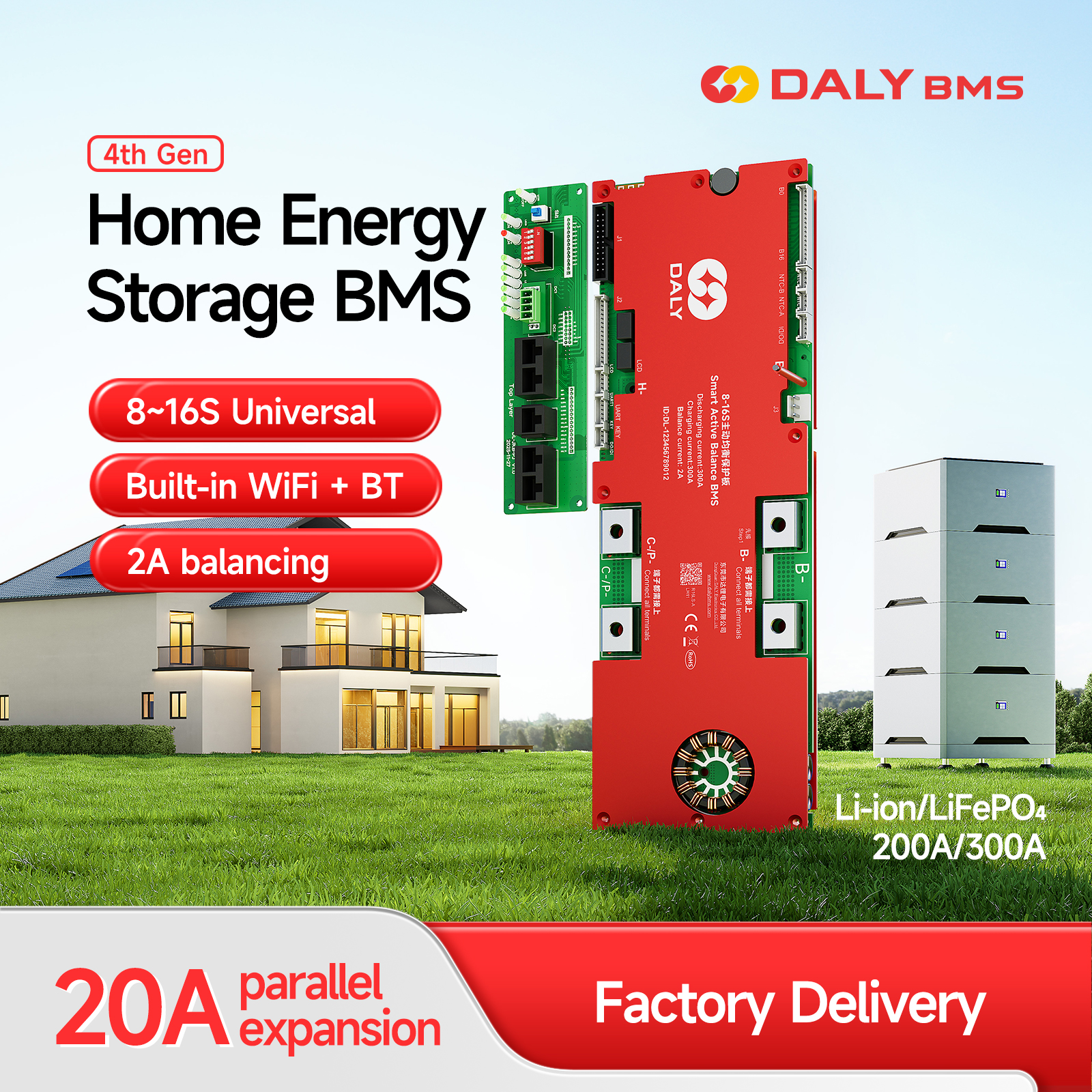
For projects that need to connect a larger number of battery packs, DALY R16LS-A is a model to consider during BMS selection. The model is available in 200A and 300A current versions and supports up to 63 battery PACKs in parallel.
This capability may be relevant to battery pack manufacturers and energy storage system (ESS) integrators planning a modular battery system. The 63-PACK figure describes the BMS model’s stated parallel-pack capability. It does not mean that any 63 battery packs can be connected in any combination. The battery design, pack compatibility, wiring, protection, communication and commissioning requirements still need to be checked for the complete project.
07 Information to Prepare Before Asking for a BMS Review
To help a BMS supplier review the project, prepare the following information:
- Battery chemistry, cell series count, nominal voltage and operating voltage range.
- Capacity and permitted charge and discharge current of each battery pack.
- Planned number of parallel packs and the proposed connection arrangement.
- Pack voltage and state-of-charge matching requirements before connection.
- Expected continuous current, peak current, peak duration and duty cycle.
- Cable, busbar, connector and branch-protection concept.
- Inverter and system-controller manufacturer, exact model, protocol and firmware version.
- Required monitoring data, alarms, communication interfaces and service functions.
- Installation temperature, enclosure conditions and maintenance requirements.
- Requested BMS model, hardware revision, firmware and optional configurations.
Ask the supplier to identify which requirements are supported by published specifications, which depend on an option or configuration, and which require engineering approval. This gives both sides a clear basis for technical review before sampling or production.
08 Does a 63-PACK BMS Define the System’s Energy Capacity?
No. The maximum number of supported battery PACKs does not define a fixed energy capacity in kilowatt-hours (kWh). Total energy depends on the verified voltage and capacity of each pack, the approved system configuration and the usable operating limits.
Do not convert the 63-PACK figure into a kWh claim without the actual pack specifications and a project-specific calculation. The system designer should calculate and verify the capacity using the approved battery data.
Conclusion
A multi-pack energy storage project should be evaluated as a complete battery and electrical system—not by a single maximum pack-count figure. Pack compatibility, current sharing, voltage conditions, protection, communication, commissioning and maintenance all matter.
DALY R16LS-A is identified in the current product knowledge baseline in the 200A / 300A class and is confirmed to support up to 63 battery PACKs in parallel. For battery pack manufacturers and ESS integrators planning a larger modular configuration, it may be worth including in the BMS shortlist and reviewing against the project requirements.
Before making a final selection, send the battery configuration, required current, planned number of packs and inverter information to DALY. The team can review the project requirements and identify which model-specific documents and engineering confirmations are needed.
Frequently Asked Questions
Q: How many battery PACKs can DALY R16LS-A support in parallel?
A: DALY R16LS-A supports up to 63 PACKs in parallel. The final installation must follow the approved product configuration and project-specific engineering requirements.
Q: Will current divide equally between all parallel battery packs?
A: Not necessarily. Differences in impedance, state of charge, temperature, pack condition and interconnection resistance can affect current in each branch.
Q: What should be checked before connecting battery packs in parallel?
A: Confirm chemistry, cell series configuration, voltage range, state-of-charge matching criteria, pack condition, interconnection design and the manufacturer’s approved connection procedure.
Q: Does the 63-PACK figure define the system’s kWh capacity?
A: No. Total energy depends on the verified voltage and capacity of each battery pack and the approved system design.
Q: Does inverter protocol auto-identification guarantee compatibility with every inverter?
A: No. Verify the exact inverter model, protocol and firmware combination for the project.
Contact: dalybms@dalyelec.com
Discuss Your Parallel Battery Project with DALY
Send DALY your battery chemistry, cell series configuration, pack capacity, current requirements, planned number of packs and inverter model.
The DALY team can review the project requirements and identify the relevant BMS configuration, available technical documents and any items that need engineering confirmation.
Contact: dalybms@dalyelec.com
Post time: Nov-21-2026


