

As lithium-ion and LiFePO4 batteries increasingly power high-value assets—from industrial forklifts and marine vessels to off-grid solar systems—the required charging infrastructure is evolving. When upgrading their power setups, fleet managers and DIY enthusiasts often face a common question: Is investing in a smart lithium charger with "real-time monitoring" a critical necessity, or just an expensive gimmick?
The answer depends entirely on the scale of your investment and how the charger interacts with your battery.
The Limitations of "Blind" Charging
Standard lithium battery chargers operate on a strict, pre-programmed Constant Current/Constant Voltage (CC/CV) algorithm. While highly reliable for basic indoor electronics, this method is fundamentally "blind." A standard charger only reads the overall voltage of the battery pack. It does not know the internal temperature, the health of individual cells, or the exact state of charge.
It simply pushes power at a fixed rate until the target voltage is reached. If a battery begins to overheat during a rapid charge cycle, a standard charger will not slow down. It relies entirely on the battery’s internal Battery Management System (BMS) to act as a last line of defense, abruptly cutting off the circuit to prevent damage. This "hard stop" is effective for safety, but triggering the BMS protection frequently can stress the electrical components over time.

Active Management via Real-Time Communication
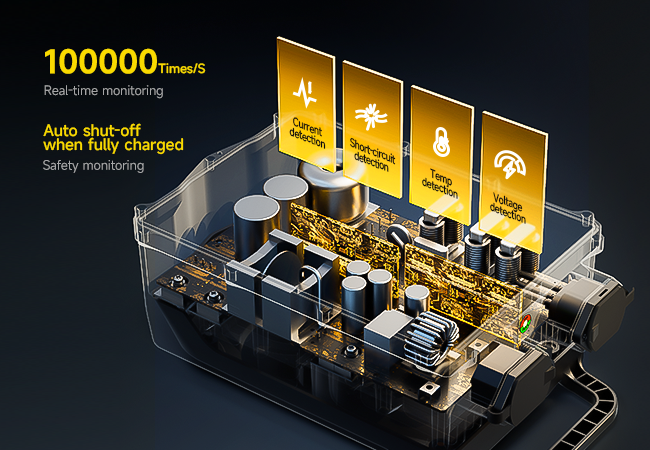
Real-time monitoring shifts the charging paradigm from passive protection to active management. Advanced smart chargers achieve this through data communication protocols (like CAN bus or RS485) that link directly to the battery’s BMS.
Instead of charging blindly, the charger and the battery "talk" to each other continuously. If the BMS detects that internal cell temperatures are rising due to high ambient heat or heavy usage, it sends real-time data to the charger. The smart charger responds dynamically, automatically lowering the amperage to cool the battery down without triggering a hard shutdown. Once temperatures stabilize, the charger ramps the current back up. This intelligent, real-time handshake ensures the fastest possible charge while actively extending the cycle life of the lithium cells.
Visibility and Fleet Maintenance
Beyond internal hardware communication, real-time monitoring offers crucial visibility for the human operator. Through Bluetooth apps or fleet management dashboards, users can monitor charging progress, input voltage, and temperature graphs in real-time. For an industrial warehouse manager, knowing exactly when a forklift will reach 100% capacity allows for precise shift scheduling. For an off-grid camper, verifying charging data ensures the solar setup is performing efficiently before heading into the wilderness.
For a small, inexpensive lithium gadget, a standard CC/CV charger is perfectly adequate. However, for high-capacity power systems where battery replacement costs thousands of dollars, a real-time monitoring charger is not a gimmick. By enabling dynamic current adjustment and providing operational visibility, it transforms a basic power transfer into a sophisticated, hardware-protecting ecosystem.

Post time: Oct-28-2026


