

How to Choose a 48V LiFePO4 BMS for Home Energy Storage
For a 16S LiFePO4 home battery, choose a BMS by checking the actual battery-side current, cell limits and inverter requirements—not the “48V” label alone. The steps below help home energy storage OEMs and battery pack manufacturers compare DALY’s 4th Generation BMS options.
1. Confirm the 16S Battery Configuration
A 16S battery pack connects 16 cells or cell groups in series. With a nominal LiFePO4 cell voltage of 3.2V, the pack’s nominal voltage is 16 × 3.2V = 51.2V. This configuration is commonly marketed as a 48V-class battery system. However, “48V” alone does not confirm the series count or the battery’s full operating-voltage range.
Before choosing a BMS, confirm the cell chemistry, series count, cell manufacturer’s voltage limits, and the battery pack’s minimum and maximum operating voltage. The BMS configuration must match the actual battery design and cell datasheet.
2. Estimate the Required Battery Current
For a preliminary estimate of battery-side discharge current, use the inverter’s AC output power, battery voltage and inverter efficiency:
For example, assume a 5kW inverter operates at 90% efficiency. At 48V, the estimated battery current is about 116A. If the battery voltage falls to an illustrative 44V, the estimate rises to about 126A.
| Battery voltage used in example | Calculation | Estimated battery current |
|---|---|---|
| 48V | 5,000 ÷ (48 × 0.90) | 115.7A (about 116A) |
| 44V | 5,000 ÷ (44 × 0.90) | 126.3A (about 126A) |
For final selection, check the inverter manufacturer’s battery-side current data, continuous power, surge current and duration, and minimum operating voltage. Check charging current separately against the charger or inverter and the cell manufacturer’s limits. Also review the current limits of the cells, cables, busbars, fuses and connectors.
For a more detailed calculation example, see DALY’s BMS current calculation guide.
3. Compare DALY 4th Generation Home Storage BMS Models
DALY’s 4th Generation Home Energy Storage BMS product information lists R16LK, R16LM-B, R16LS-A and R16LS-B for 8S–16S Li-ion and LiFePO₄ battery configurations. Their current information and function options differ:
| Model | Current information | Balancing | Wireless / heating |
|---|---|---|---|
| R16LK | 100A continuous charge/discharge; 120A customizable | 150mA passive; optional 1A peak active | Bluetooth/WiFi optional; heating module optional |
| R16LM-B | 150A / 200A continuous charge/discharge | 150mA passive; optional 2A peak active | Bluetooth/WiFi optional; heating module optional |
| R16LS-A | 200A / 300A rated current | Standard 2A active; no passive balancing | Bluetooth/WiFi built in; optional 20A heating |
| R16LS-B | 300A rated current | 150mA passive; optional 2A active | Bluetooth/WiFi optional; built-in 20A heating |
UART, RS485 and CAN are listed as standard interfaces on all four models. Having an interface does not automatically confirm compatibility with a specific inverter. Check the inverter brand and exact model, required protocol and version, and any integration requirements before ordering.
4. Check Balancing, Heating and Parallel-System Requirements
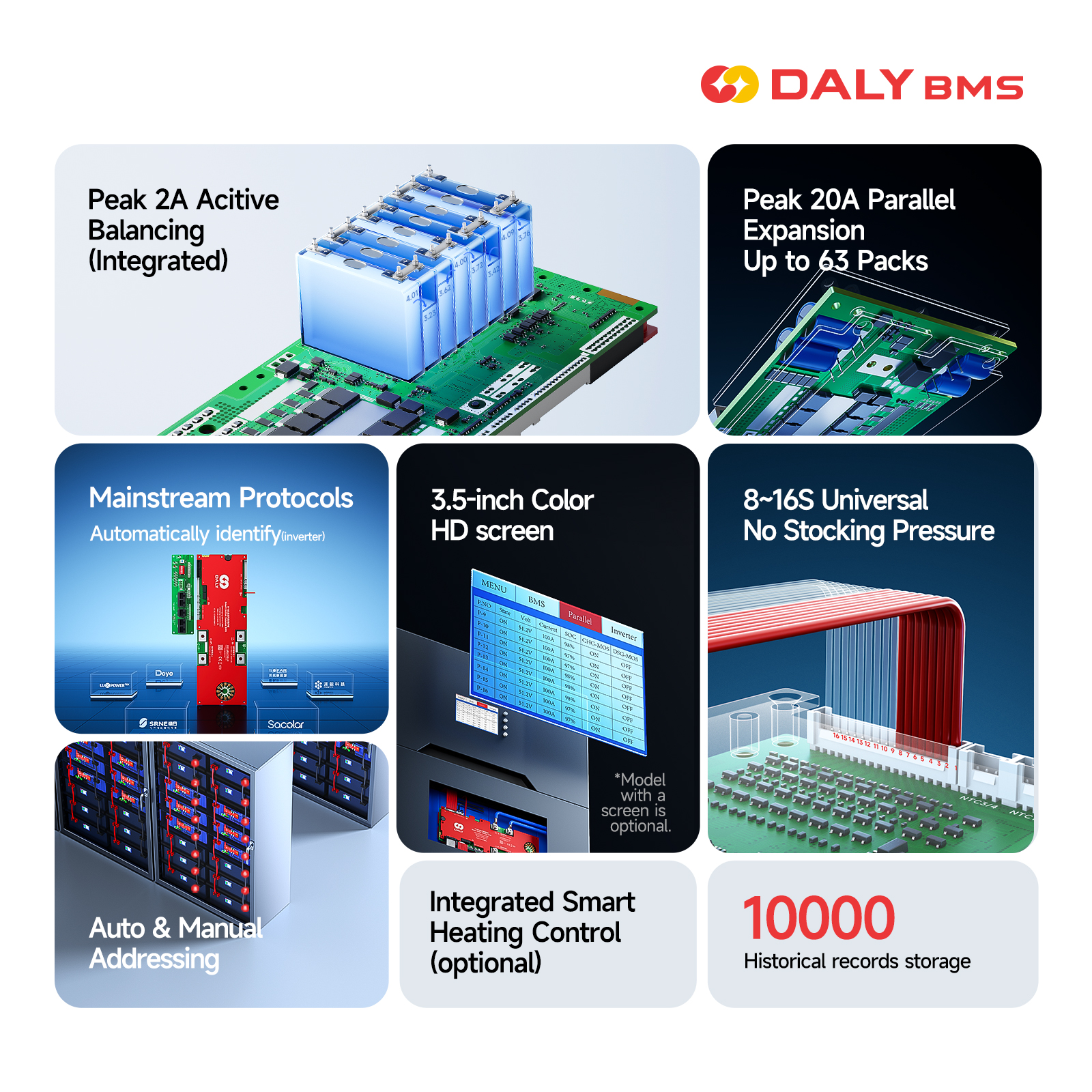
Balancing configurations differ by model. R16LS-A lists standard 2A active balancing and no passive balancing. R16LK, R16LM-B and R16LS-B list 150mA passive balancing, with active balancing available as an option. The 1A and 2A active-balancing values identified as peak values should not be described as continuous balancing current.
Heating and wireless functions also vary. R16LK and R16LM-B list optional heating modules and optional Bluetooth/WiFi. R16LS-A lists built-in Bluetooth/WiFi and optional 20A heating. R16LS-B lists optional Bluetooth/WiFi and built-in 20A heating. Confirm the required configuration in the quotation or order specification.
For parallel battery systems, review pack voltage matching, current sharing, protection coordination, communication and fault isolation at system level. Do not estimate the permitted system current by simply multiplying one BMS rating by the number of packs.
5. Prepare Your Project Details for B2B Selection
To support a model-specific technical review, battery manufacturers and system integrators should prepare:
- Battery chemistry, series count and capacity (Ah)
- Cell manufacturer, model and datasheet voltage/current limits
- Battery operating-voltage range
- Inverter brand, exact model, rated power and surge requirement
- Required continuous charge/discharge current and peak current with duration
- Communication interface and protocol (CAN or RS485)
- Required options: active balancing, Bluetooth, WiFi, heating or display
- Number of parallel packs and estimated order quantity
If some information is not yet available, identify the missing items rather than estimating them. You can still send the battery and inverter details available so the required follow-up specifications can be identified.
Conclusion
Choosing a 48V-class BMS starts with confirming the 16S battery design, cell limits, current requirements and inverter protocol. DALY’s R16LK, R16LM-B, R16LS-A and R16LS-B have different current definitions and function configurations. Compare the exact model information with the battery and inverter requirements before confirming a selection.
Planning a 16S home energy storage battery? Send DALY your battery and inverter specifications, current requirements, communication needs and estimated quantity for a project-specific review.
Frequently Asked Questions
Is a 16S LiFePO4 battery a 48V battery?
A 16S LiFePO4 pack has a nominal voltage of 51.2V when using 3.2V nominal cells. It is commonly described as a 48V-class system, but its actual voltage changes during operation.
Do all four DALY models have the same current definition?
No. R16LK and R16LM-B are listed with continuous charge/discharge current. R16LS-A and R16LS-B are listed by rated current; confirm their continuous and peak-current limits for the exact configuration.
Do all four models support CAN and RS485?
UART, RS485 and CAN are listed as standard interfaces on all four models. Compatibility still depends on the inverter model and communication protocol.
References
Post time: Nov-28-2026


