
A LiFePO4 battery pack without a BMS is an unguarded liability.
One overcharge event can permanently destroy cells. The wrong BMS
causes months of phantom cutoffs and wasted capacity. This guide
covers everything you need to make the right decision.
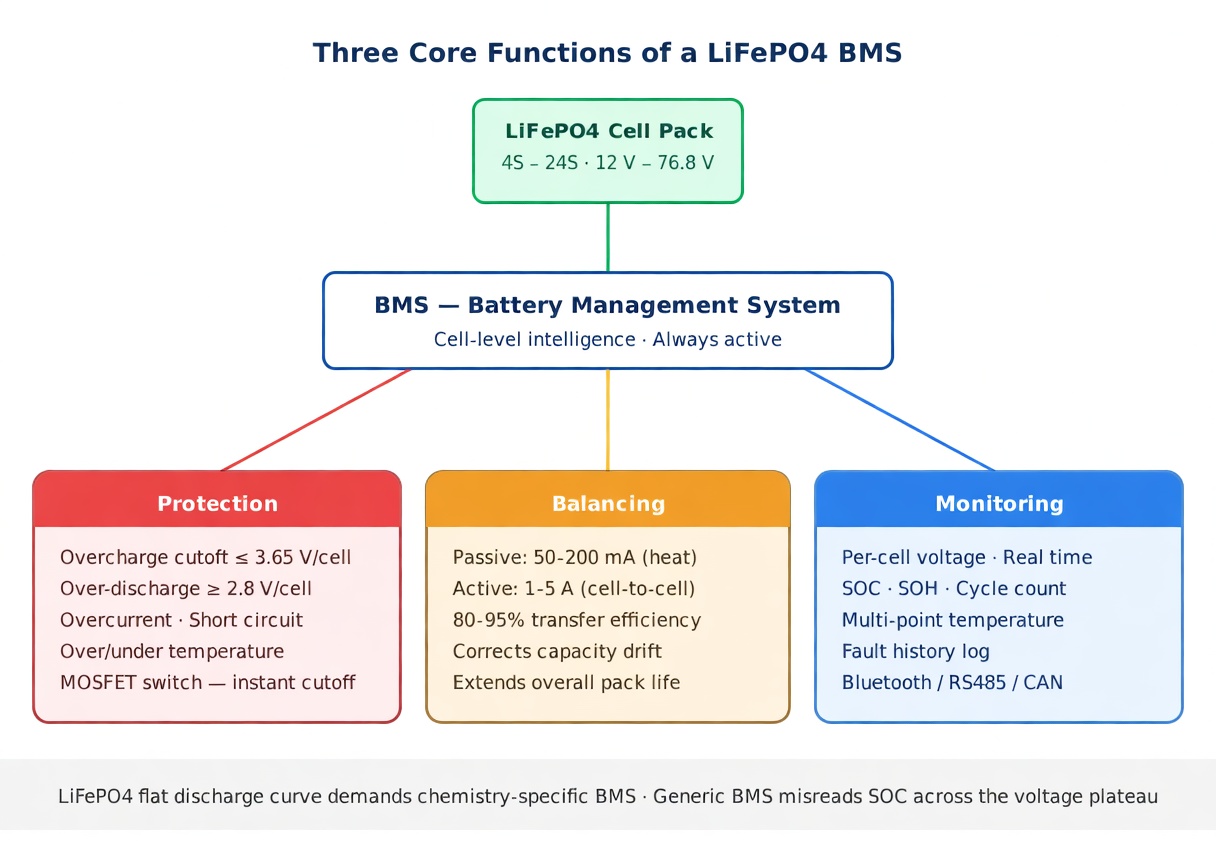
A BMS performs three jobs simultaneously:
Protection cuts the circuit the moment any cell exceeds its safe window — charge above 3.65 V/cell, discharge below 2.8 V/cell (recommended operating threshold), or when current, temperature, or short-circuit conditions become dangerous.
Balancing corrects the natural drift between individual cells over hundreds of cycles. Without it, your weakest cell defines your entire pack's usable capacity — and degrades fastest.
Monitoring tracks state of charge (SOC), state of health (SOH), per-cell voltage, temperature, and cycle count in real time. This data lets you catch a failing cell before it takes down the pack.
LiFePO4's uniquely flat discharge curve demands a chemistry-specific BMS. A generic BMS will misread SOC across the entire plateau and trigger false low-voltage cutoffs with significant capacity remaining.
How to Size Your BMS
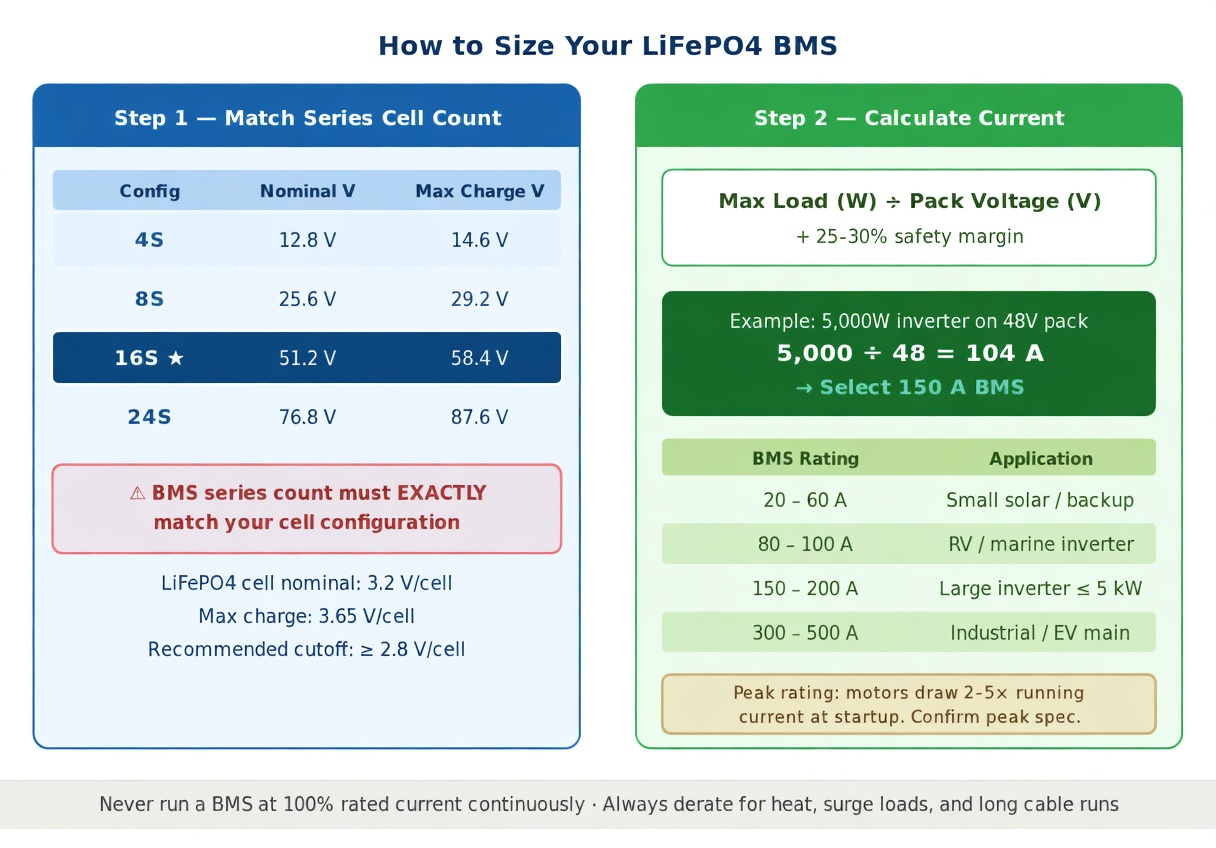
Two specs must match your pack exactly.
Step 1 — Voltage (series cell count). A 4S pack needs a 4S BMS. A 16S pack needs a 16S BMS. One cell off causes systematic voltage misreading and unreliable protection.
| Config | Nominal Voltage | Max Charge Voltage | Typical Application |
|---|---|---|---|
| 4S | 12.8 V | 14.6 V | RV, marine, off-grid |
| 8S | 25.6 V | 29.2 V | Trolling motors, 24V solar |
| 16S | 51.2 V | 58.4 V | Home storage, golf cart |
| 24S | 76.8 V | 87.6 V | 72V EV, industrial |
Step 2 — Current. Divide your maximum continuous load in watts by pack voltage, then add 25–30% safety margin.
5,000 W ÷ 48 V = 104 A → Select a 150 A BMSNever run a BMS at 100% of its rated current. Heat derating and surge loads always push real-world demand above the calculated figure.
Active vs. Passive Balancing
Passive balancing wastes excess charge as heat through a resistor (50–200 mA). It keeps well-matched packs aligned but cannot recover significant cell drift — correcting a 500 mAh imbalance takes approximately 5 hours at 100 mA.
Active balancing transfers energy between cells via an inductor-capacitor circuit (1–5 A, 80–95% efficiency). It corrects imbalance 10–50× faster and operates throughout the full charge and discharge cycle, not just at the top.
| Scenario | Passive | Active |
|---|---|---|
| Same-batch cells, ≤ 0.3C cycling | Sufficient | Marginal improvement |
| Pack ≥ 200 Ah, daily deep cycling | Struggles | Recommended |
| Discharge rate > 0.5C continuous | Cannot track | Required |
| Mixed-batch or aged cells | Cannot recover | Can recover pack |
Choose passive for same-batch cells cycled at ≤ 0.3C.
Choose active for packs ≥ 200 Ah, discharge rates above 0.5C, or cells from mixed batches.
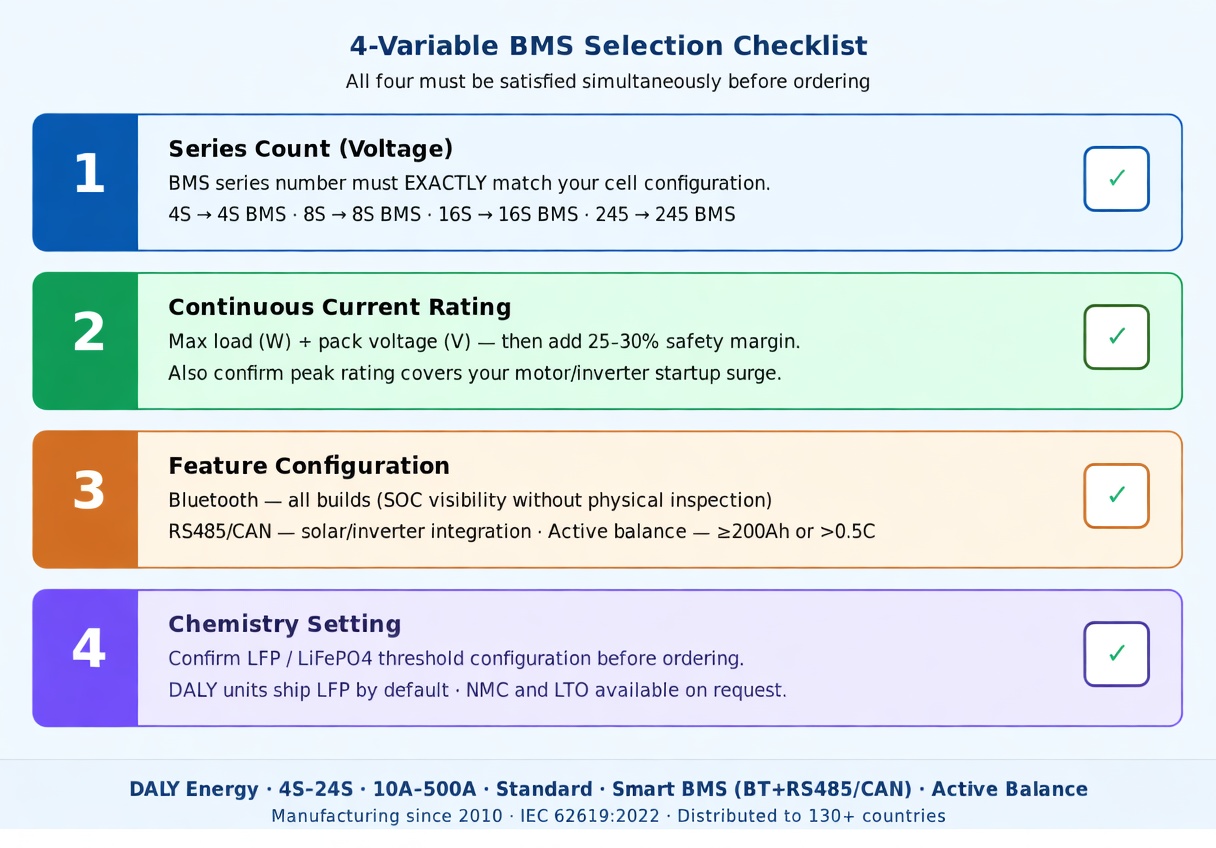
Four-Variable Selection Checklist
Before ordering, verify all four variables simultaneously:
| Variable | Requirement |
|---|---|
| Series count | Exactly matches your cell configuration |
| Continuous current | Max load (W) ÷ voltage (V) + 25–30% margin |
| Features | Bluetooth (all) · RS485/CAN (solar) · Active balancing (≥ 200 Ah) |
| Chemistry | Confirm LFP/LiFePO4 threshold configuration |
DALY Energy BMS units cover 4S through 24S and 10 A through 500 A, in standard, smart (Bluetooth + RS485/CAN), and active balance configurations — all shipped with LFP chemistry thresholds by default.
Ready to select your BMS?
Browse DALY LiFePO4 BMS →
Contact Engineering Team →
Last updated: March 2026 · DALY Energy Engineering Team · IEC 62619:2022 compliant product line
Post time: Mar-28-2026


