

Sourcing a battery management system for an e-bike, electric scooter, or electric motorcycle program is a different problem from sourcing one for a forklift or stationary storage system. The pack is smaller, the cost target is tighter, the form factor is space-constrained, and the production volume is high. A BMS that fits the application matters more than one with the highest possible specifications.
For two-wheel EV programs, the right LiFePO4 BMS is defined by four parameters: continuous current rating between 40A and 200A to cover everything from light scooters to high-performance e-motorcycles and cargo tricycles, series count covering 4S to 24S to span 12V through 72V nominal packs, passive or active cell balancing matched to the duty cycle, and a compact form factor that fits inside the chassis battery compartment. Communication is optional but increasingly expected — Bluetooth-based mobile diagnostics are now standard on mid-range and premium two-wheel EV products.
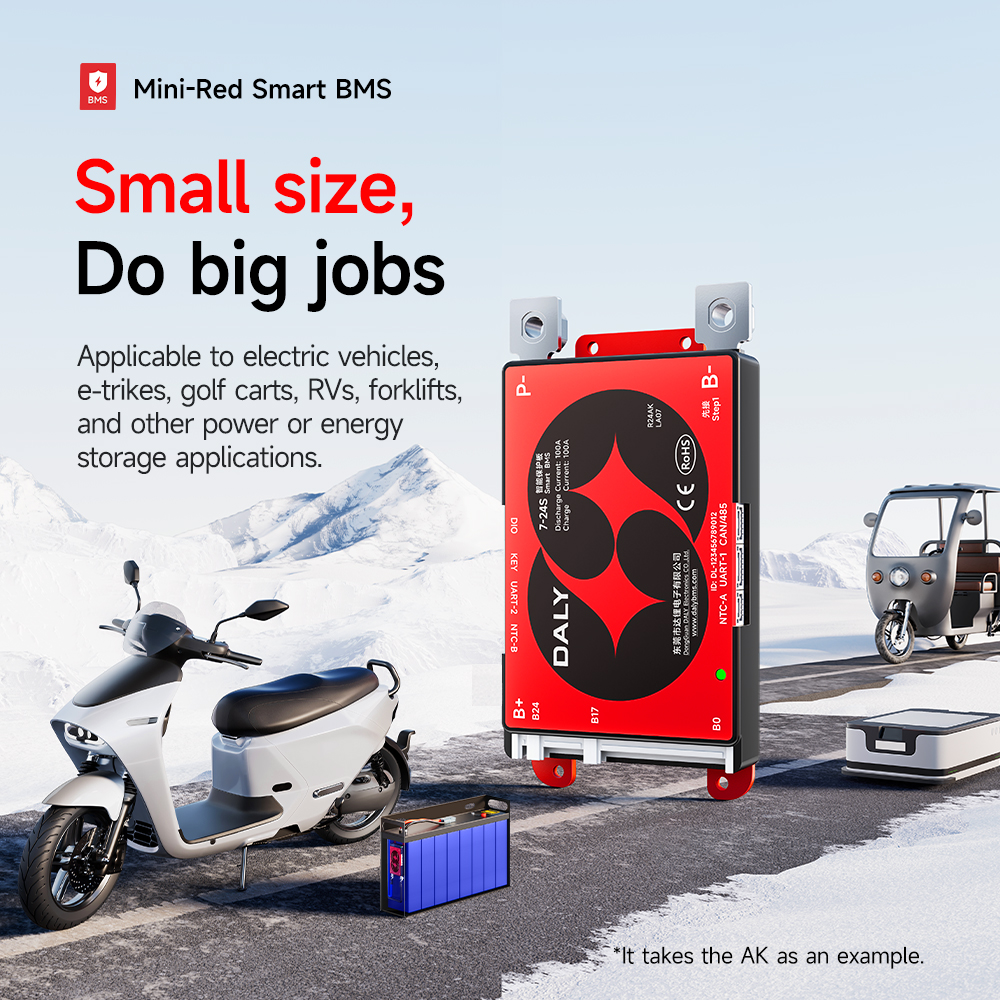
BMS Selection Map for Two-Wheel EV Voltage Tiers
Match your nominal pack voltage to the corresponding series count, then select the BMS series that covers your continuous current and balancing requirement. The table below maps the most common two-wheel EV voltages to recommended product series.
|
Pack Voltage |
Series Count (LFP) |
Typical Continuous Current |
Recommended Series |
| 36V nominal | 12S | 40A–60A | AH (Passive) / TH (Active) |
| 48V nominal | 16S | 40A–100A | AH / AK (Passive) / TH / TK (Active) |
| 60V nominal | 20S | 60A–200A | AK / AM (Passive) / TK / TM (Active) |
| 72V nominal | 24S | 80A–200A | AK / AM (Passive) / TK / TM (Active) |
If your application falls between two rows — for example a 48V pack drawing 75A continuous with a 130A startup peak — the AK Series at 100A is the correct selection, because the 100A continuous rating provides the 20–30% headroom recommended in IEC 60204-1 while the peak protection threshold and response delay can be configured to ride through the 130A inrush without nuisance trips. For higher-current applications such as a 60V or 72V e-motorcycle drawing 130A continuous with 220A peaks, the AM Series at 150A (passive) or TM Series at 150A (active) is the corresponding selection.
| → Need help confirming the right series for your pack? |
DALY LiFePO4 BMS Range for Two-Wheel EV Applications
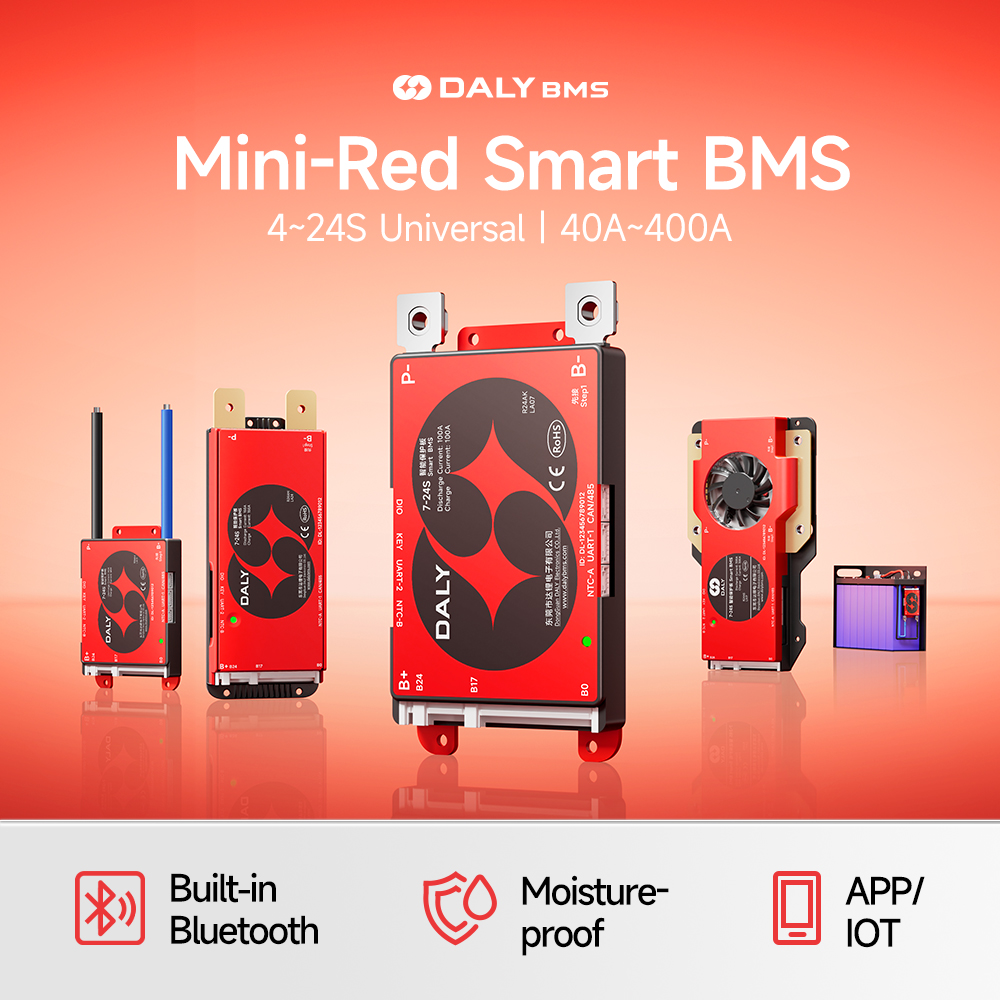
Six product series cover the full two-wheel EV current and voltage map. AH, AK, and AM are passive balancing for cost-sensitive volume programs across light, mid, and high-current classes; TH, TK, and TM are active balancing for applications targeting longer service life, fleet-grade utilisation, or operation across wider temperature ranges.
|
Series |
Balancing |
Continuous Current |
LFP Series Range |
Typical Application |
| AH Smart BMS | Passive 100±30mA | 40A / 60A | 4–8S / 7–17S / 7–24S | Self-balancing scooter, e-scooter, light EV |
| AK Smart BMS | Passive 100±30mA | 80A / 100A | 4–8S / 7–17S / 7–24S | E-bike, e-scooter, e-motorcycle, e-tricycle |
| TH Active Balance | Active Peak 1000mA | 40A / 60A | 4–8S / 7–17S / 7–24S | Premium scooter, fast-charge two-wheel EV |
| TK Active Balance | Active Peak 1000mA | 100A | 7–17S / 7–24S | Premium e-motorcycle, e-tricycle, fleet two-wheel EV |
| AM Smart BMS | Passive 100±30mA | 150A / 200A | 7–17S / 7–24S | High-performance e-motorcycle, cargo e-tricycle |
| TM Active Balance | Active Peak 1000mA | 150A / 200A | 7–17S / 7–24S | Premium high-performance e-motorcycle, fleet cargo tricycle |
All six series support LiFePO4, NCM (ternary lithium), and LTO chemistries from a single product family. Bluetooth is built in as standard across the range. WiFi, 4G positioning, heating module, display, buzzer, and key switch are available as optional add-ons. RS485 and CAN bus communication are standard; UART is provided as UART×2 on the passive-balancing series (AH / AK / AM) and UART×1 on the active-balancing series (TH / TK / TM). One configuration difference to note: AH and AK in the Light Weight 2W class include a built-in secondary protection layer, while the TH series in the same class is shipped without secondary protection — confirm with our engineering team if your design requires a redundant protection path. All series carry CE, RoHS, FCC, and EAC certifications for export to EU, North America, and CIS markets.
Three Sourcing Mistakes That Surface Three Months Later
Mistake 1 — Specifying continuous current at exactly the load current.
An 80A continuous load paired with an 80A BMS will trip during startup inrush, during seasonal high-temperature derating, and as the pack ages. Industry sizing practice for inverter and motor-drive applications recommends 20–30 percent headroom
. For an 80A motor drive on a 48V pack, specify the AK or TK Series at 100A continuous, not the 80A class. The same logic scales upward: a 130A continuous load on a 60V e-motorcycle should specify the AM or TM Series at 150A; a 170A continuous load should specify the 200A variant of AM or TM rather than the 150A class.
| → Unsure how to convert your motor controller's stall current into BMS continuous rating?
Send the controller datasheet for a calculated recommendation: dalybms.com/contact/ |
Mistake 2 — Mismatching series count to pack voltage.
Series count is fixed at the BMS hardware level and cannot be changed in the field. A 16S BMS installed on a 13S pack leaves three voltage monitoring channels unused and applies incorrect protection thresholds across the entire pack. Always confirm the exact cell count of your pack — including any series additions made in pack assembly — before placing the BMS order.
Mistake 3 — Treating Bluetooth as optional when end customers expect it.
Two-wheel EV end customers in 2026 expect a mobile app showing battery state of charge, range estimation, and fault alerts. A BMS without Bluetooth means the OEM must source and integrate a separate display module, adding cost and a failure point. AH, AK, AM, TH, TK, and TM all include Bluetooth as standard, removing this hidden integration cost from the BOM.
Application Notes by Vehicle Class
Self-Balancing Scooter and Light Electric Scooter (36V–48V).
These applications run at 40A–60A continuous with brief 80A startup peaks. The AH Series at 60A continuous covers the standard configuration; the BMS peak protection threshold and response delay should be configured to ride through the inrush window without nuisance trips. Pack space is the binding constraint — AH at 96 by 65 by 13.6 mm and 140g fits inside the chassis tube of most folding scooter designs without modification.

Electric Motorcycle and High-Performance Scooter (48V–72V).
Electric motorcycles draw 100A continuous on standard models and 150A–200A on high-performance and large-displacement models, with regenerative braking adding additional thermal load. For the standard 100A class, the AK Series (passive balancing) is the volume specification, while the TK Series (active balancing) is the upgrade for premium models targeting extended service life or fleet-grade capacity retention. For high-performance models drawing 150A or 200A continuous, the AM Series (passive, 150A/200A) covers cost-sensitive volume programs and the TM Series (active, 150A/200A) is the choice for premium e-motorcycle platforms requiring active balancing across higher discharge rates. AK, AM, TK, and TM all share the 7–17S / 7–24S LFP series range needed for 48V–72V two-wheel EV packs.
Electric Tricycle (48V–72V Cargo and Passenger).
Cargo tricycles in last-mile delivery and passenger tricycles in shared mobility see daily cycling at higher utilisation than personal e-bikes. For standard 100A configurations at 16S or 20S, the AK Series (passive balancing) is the volume specification and the TK Series (active balancing) is the upgrade for fleet operators targeting longer pack life between replacements. Heavy-load cargo tricycles drawing 150A or 200A continuous fall into the AM Series (passive 150A/200A) or TM Series (active 150A/200A) — the same Electric Tricycle BMS family as AK/TK, so the procurement and integration footprint is consistent across the current range.
Standard vs Active Balancing — Decision Matrix for This Application Class
Across the 40A–200A two-wheel EV range, the choice between passive balancing (AH / AK / AM) and active balancing (TH / TK / TM) depends on cycle frequency, charge profile, operating temperature, and target service life. The matrix below is a starting reference for procurement and engineering teams; final selection should account for pack design, cell specification, and motor controller behavior, and we recommend confirming the configuration with our engineering team before order placement.
|
Decision Factor |
Choose Passive (AH / AK / AM) |
Choose Active (TH / TK / TM) |
| Daily cycling rate | Personal use, weekly riding | Fleet, daily commuting, shared mobility |
| Charge window | Slow charge, scheduled overnight or off-peak | Frequent fast-charge cycling between rides |
| Target service life | Standard pack service life under typical use | Extended service life under heavy-duty or high-utilisation use |
| Cell matching at assembly | Cells from a single batch with consistent grading | Long-cycle drift compensation, or packs with wider initial cell variance |
| Operating temperature range | Operation within a moderate, stable temperature range | Operation across wide ambient temperature variation |
| Budget priority | Lowest unit cost | Lowest total cost of ownership |
Why Source Direct from DALY Factory
DALY has manufactured battery management systems from Dongguan since 2015. Sourcing factory-direct rather than through a trading channel gives a B2B program four advantages that matter at the production stage:
- Direct engineering access — design and production questions go to the engineers who built the product, not to an account manager forwarding emails
- OEM and ODM support — custom labelling, custom protection thresholds programmed at factory, and custom firmware for proprietary host systems are available at qualifying volumes
- Production schedule visibility — committed lead times direct from the manufacturer, not estimates from an intermediary
- Direct warranty and field support — quality issues resolve at factory level without the intermediary delay
B2B Buyer's Frequently Asked Questions
Q: How do I confirm my motor controller's actual peak inrush current before specifying BMS continuous rating?
A: Motor controller datasheets typically list nominal current and stall current separately. The stall current — drawn for the first 100 to 500 milliseconds at startup — is what the BMS must absorb without tripping. As a working reference, BMS continuous current rating should be specified at approximately 1.2–1.3 times the controller’s nominal continuous current, in line with the 20–30% headroom principle in IEC 60204-1 for motor-drive sizing. The peak protection threshold and its response delay should then be configured together so the BMS rides through the controller’s startup inrush (typically 100–500 ms) without nuisance trips, while still triggering protection on a true overcurrent fault. Because the appropriate threshold and delay window depend on the specific controller, pack voltage, and cell specification, we recommend confirming the final values with our engineering team rather than applying a fixed multiplier. If your controller datasheet does not separate these values, send the datasheet and pack voltage to our engineering team and we will return a matched BMS recommendation within 24 hours.
Q: What is the lead time for 500-unit and 5,000-unit orders?
A: Lead time depends on series, configuration, and current production loading. Standard configurations typically ship faster than custom OEM configurations with programmed protection thresholds or custom labelling. Send your target volume, configuration, and required ship-by date to our sales team for a committed lead-time quote.
Q: Can DALY program custom OVP, UVP, and OCP thresholds at the factory?
A: Yes. Custom protection threshold programming is available as part of OEM configuration. This eliminates the need for field calibration and ensures every unit shipped matches your validated cell specification. Specify your cell manufacturer, exact chemistry, and target threshold values when placing the OEM order.
Q: AK Series versus TK Series for a 48V 100A e-motorcycle program — what is the actual difference?
A: AK and TK share the same 100A continuous rating and the same LFP series range (7–17S / 7–24S), so for a 48V (typically 16S LFP) e-motorcycle pack both will physically fit and carry the load. The differences are in three areas:
• Balancing method. AK uses passive (resistor-dissipative) balancing at 100±30 mA, which engages when cell voltage deviation exceeds the configured threshold during the constant-voltage charge stage and dissipates excess charge from higher-voltage cells as heat. TK uses active (charge-transfer) balancing at peak 1000 mA, which can engage in charge, discharge, and rest states once the deviation threshold is met, redistributing energy between cells rather than dissipating it.
• Communication interface. AK provides UART×2; TK provides UART×1. Both carry RS485 and CAN as standard. If your host system needs two independent UART channels (for example a separate display module and a dashboard MCU), AK fits without an external splitter.
• BOM cost and thermal profile. Active balancing requires additional power-conversion components, so TK carries a higher unit cost than AK; passive balancing dissipates as heat, so AK’s thermal load on the pack rises with balancing current, while TK’s heat generation during balancing is comparatively lower.
In application terms: for personal-use e-motorcycles with overnight or off-peak charging and moderate cycle frequency, AK is typically the lower-BOM-cost option that meets the duty cycle. For fleet deployment, daily fast-charge cycling, or programs prioritising long-term cell-to-cell consistency under high-utilisation conditions, TK’s active balancing provides better capacity retention margin as cell variance accumulates over cycles. Because the actual benefit depends on cell grade, charging profile, and operating temperature, we recommend confirming the choice against your specific pack design with our engineering team before finalising the BOM.
Q: Do you provide pre-shipment QC reports or third-party inspection access?
A: Pre-shipment QC documentation is included for all qualified B2B orders. Third-party inspection (SGS, Bureau Veritas, BV, or buyer-nominated agency) is supported — coordinate inspection booking with our sales team during PO confirmation to align with the production schedule.
| Want a factory-direct B2B quote for your two-wheel EV BMS program?Send pack voltage, continuous current, and target volume to our team for a quote within 24 hours.
▶ Get B2B Quote → dalybms.com/contact/ ▶ Standard BMS Range → dalybms.com/standard-bms/ ▶ Active Balancing BMS Range → dalybms.com/smart-bms/ |
Post time: Apr-25-2026


