

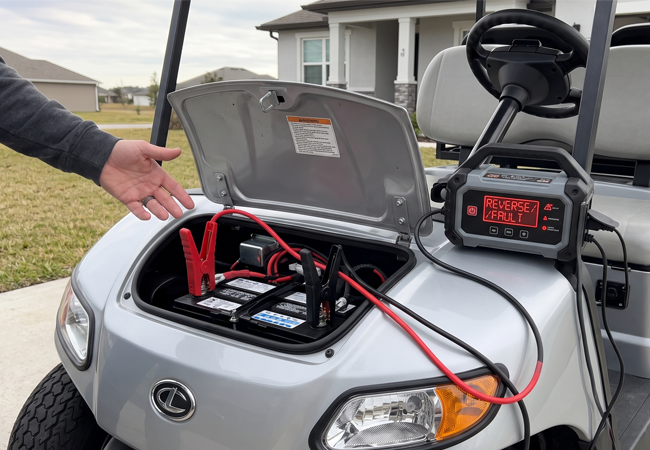
Upgrading a golf cart, RV, or marine vessel to a lithium power system often involves working in cramped, poorly lit battery compartments. In these demanding conditions, accidentally connecting a charger's red positive cable to the negative terminal is a common, yet potentially catastrophic mistake. With a standard legacy charger, this reverse polarity will instantly trigger a massive short circuit, generating intense heat that can melt cables and permanently destroy your expensive LiFePO4 battery. Fortunately, this entire disaster can be prevented by utilizing a smart lithium charger equipped with built-in reverse connection protection.
The Physics of Reverse Polarity
To understand why this mistake is so dangerous, we must examine how electricity flows. Batteries and chargers operate on Direct Current (DC), which has a strict directional flow. When you connect a charger correctly, the voltages push against each other in a controlled manner, allowing the charger's slightly higher voltage to push energy safely into the battery cells.
When you connect the cables backward, the voltages of the charger and the battery no longer oppose each other—they combine. This creates a closed-loop circuit with virtually zero electrical resistance. Instantly, an uncontrolled surge of massive current rushes through the wires.
The Catastrophic Damage to Standard Equipment
If your equipment lacks modern hardware fail-safes, a reverse connection is disastrous. The massive current spike immediately generates extreme heat. You will likely witness aggressive sparking at the terminals, and the plastic insulation on the alligator clips can melt in a matter of seconds.
Internally, the standard charger's fuses will blow immediately. In many cheap chargers, these fuses are soldered directly onto the motherboard and cannot be replaced by the user, rendering the entire unit useless. Worse still, this reverse voltage spike can bypass the charger entirely and strike the battery's Battery Management System (BMS). This aggressive spike can easily fry the sensitive MOSFETs (electronic switches) inside the BMS, permanently killing your costly lithium investment.

The Industry Solution: Smart Reverse Connection Protection
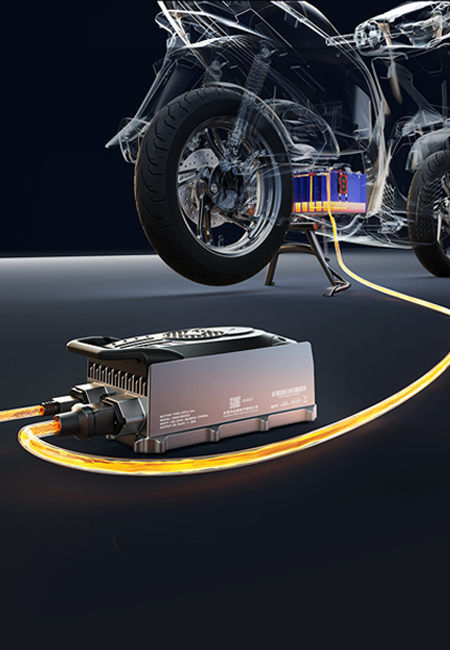
Because human error is inevitable in DIY projects and harsh industrial environments, industry experts mandate that modern lithium charging infrastructure must account for reverse polarity. When evaluating a charger for your off-grid or fleet applications, "Reverse Connection Protection" is a non-negotiable feature.
High-quality smart chargers operate with an intelligent electronic safety gate. When you plug them into a battery, they do not output power immediately. Instead, the charger's internal microprocessor takes a fraction of a second to "read" the battery's terminal voltage and polarity. If the microprocessor detects that the cables are reversed, it keeps the internal relays physically open. The circuit remains broken, zero sparks are generated, and a fault indicator light usually turns on to alert the user. Only when the cables are swapped to the correct terminals will the charger unlock and initiate the Constant Current/Constant Voltage (CC/CV) charging algorithm.
A momentary lapse in concentration in a dark garage should not cost you thousands of dollars in ruined equipment. By ensuring your lithium setup is paired with a smart tech-charger featuring strict microprocessor-controlled reverse connection protection, you eliminate the risk of reverse polarity entirely.

Post time: Oct-12-2026


