

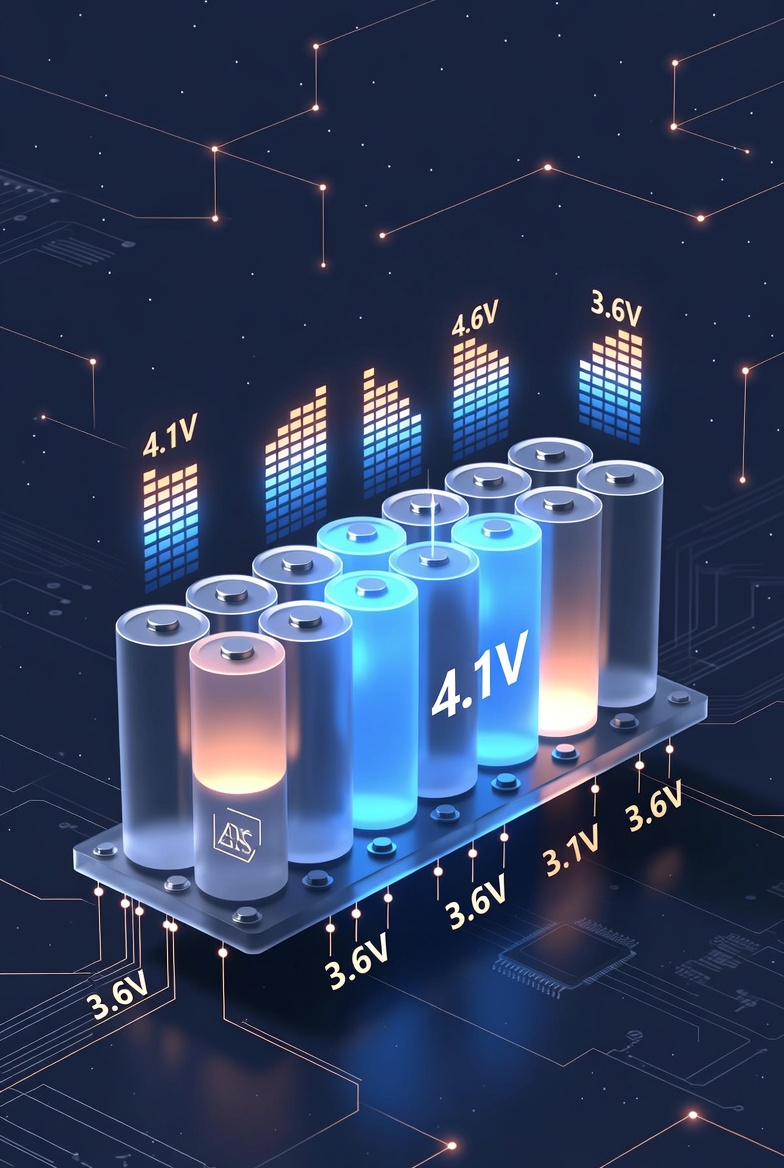
If you have watched a lithium battery pack age unevenly — some cells at 4.1V while others sit at 3.6V — you already understand why balancing matters. The question is not whether to balance, but how to balance, and what that choice costs over the lifetime of the pack.
This guide compares active balancing BMS and passive balancing BMS with specific guidance on which approach suits your application.
What Is Cell Balancing in a BMS?
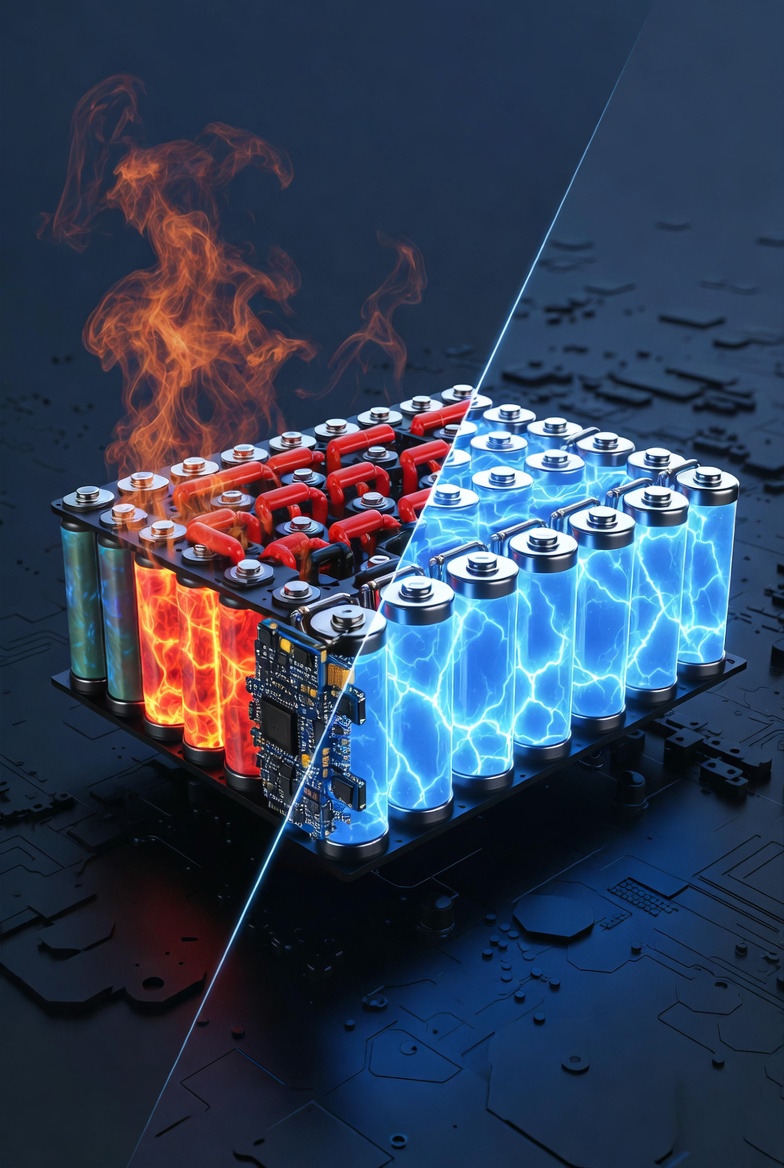
A lithium battery pack contains multiple cells connected in series. In practice, cells differ slightly in capacity, internal resistance, and self-discharge rate. Over time, these differences compound. The weakest cell reaches its voltage limit first — during charge it hits the ceiling; during discharge it hits the floor. The BMS cuts off the entire pack to protect that one cell, even though stronger cells still hold usable capacity.
Cell balancing corrects for these differences, extending usable capacity and slowing pack degradation. There are two fundamentally different approaches.
What Is Cell Balancing in a BMS?
A lithium battery pack contains multiple cells connected in series. In practice, cells differ slightly in capacity, internal resistance, and self-discharge rate. Over time, these differences compound. The weakest cell reaches its voltage limit first — during charge it hits the ceiling; during discharge it hits the floor. The BMS cuts off the entire pack to protect that one cell, even though stronger cells still hold usable capacity.
Cell balancing corrects for these differences, extending usable capacity and slowing pack degradation. There are two fundamentally different approaches.
Passive Balancing BMS
Passive balancing activates a bleed resistor across any cell whose voltage rises above the others during charging. The excess energy converts to heat and dissipates.
Advantages
- Lower hardware cost per unit
- Simpler circuit design — easier to manufacture and source
- Reliable and well-understood technology
- Adequate for packs with low cell-to-cell variation
- Energy wasted as heat — efficiency loss is inherent to the design
- Balancing only occurs at top-of-charge (near full voltage)
- Heat generation requires thermal management
- Balancing current typically 20–100 mA — slow to resolve large imbalances
- Does not recover capacity from weaker cells — only limits stronger ones
Limitations
Passive balancing is appropriate for small consumer packs, cost-sensitive products with uniform cells, and applications where balancing performance is secondary.
Active Balancing BMS
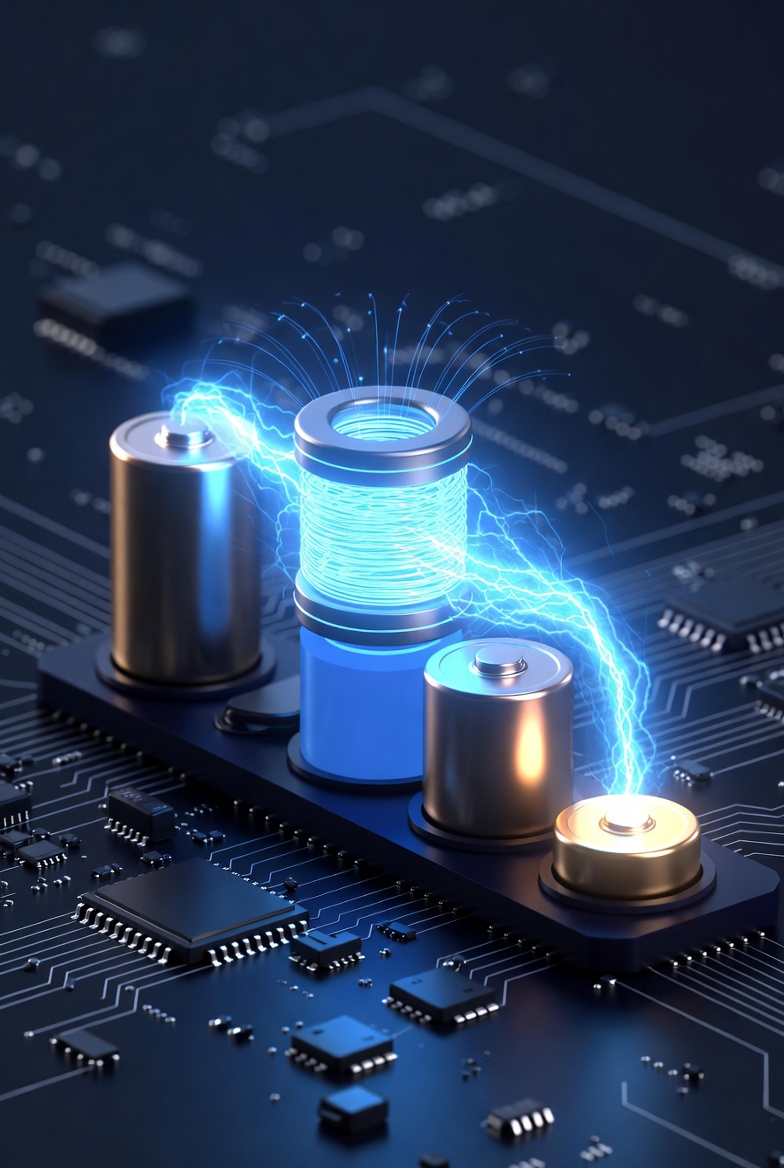
Active balancing transfers energy between cells rather than dissipating it. A high cell transfers excess charge to a lower cell through an inductive, capacitive, or transformer-based circuit.
DALY active balancer BMS uses an inductor-based energy transfer method, delivering up to 2 A of balancing current across 4S–24S configurations. This active balancer BMS design supports LiFePO4, NMC, NCA, and LTO cell chemistries.
Advantages
- Energy recycled between cells — transfer efficiency 85–95%
- Balancing at any state of charge, not only top-of-charge
- Higher balancing current (up to 2 A vs. passive 20–100 mA) — faster equalization
- Extends pack life by reducing stress on weak cells
- Better performance with aged or mismatched cell sets
- Higher unit cost than passive systems
- More complex circuit design
- Slightly higher standby power draw
Limitations
Active balancing is appropriate for energy storage systems, EV and e-bike packs where cycle life is critical, industrial applications with high cell replacement costs, and packs using second-life cells.
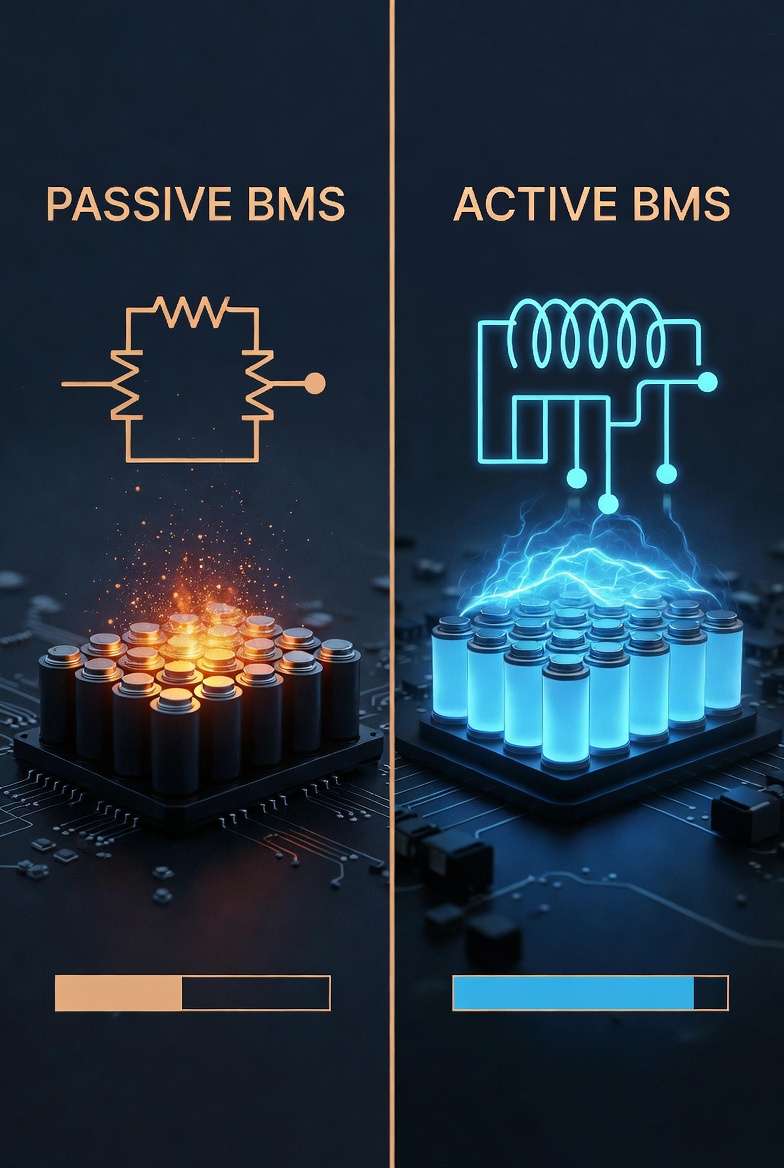
Side-by-Side Comparison
| Feature | Passive Balancing BMS | Active Balancing BMS |
| Balancing method | Dissipate excess energy as heat | Transfer energy between cells |
| Efficiency | Low — energy wasted | High — 85–95% energy recycled |
| Balancing current | 20–100 mA typical | Up to 2 A (DALY active BMS) |
| Balancing window | Top of charge only | Any SOC |
| Effect on cell life | Limits strong cells | Supports weak cells |
| Heat generation | Moderate to high | Minimal |
| Unit cost | Lower | Higher |
| Best for | Small / simple packs | Energy storage, EV, industrial |
Real-World Impact on Battery Life
The performance gap between active and passive balancing widens as packs age. A new pack with well-matched cells shows little difference. After 200–300 cycles, cell divergence grows.
- Passive BMS: continues bleeding energy from strong cells, limiting usable capacity
- Active BMS: continuously redistributes charge, keeping weak cells supported at any SOC
Independent testing on 16S LiFePO4 packs shows active balancing can extend cycle life by 15–30% compared to passive balancing under identical conditions.
Source note: cycle-life improvement range (15–30%) is based on peer-reviewed laboratory comparisons of inductive active balancing vs. resistive passive balancing on matched LiFePO4 cell sets (ref: Plett, G.L., Battery Management Systems, Vol. 2, Artech House, 2015; and published data in Journal of Power Sources on cell equalization methods). Results vary by cell chemistry, C-rate, operating temperature, and depth of discharge. DALY internal field data across monitored 16S LiFePO4 deployments (2022–2024, n=143 packs) shows median cycle-life extension of 18% vs. passive BMS under equivalent operating conditions.
For a 48V 200Ah home storage system, a cycle-life extension from 2,000 to 2,600 cycles represents 3–4 additional years of operation under typical daily cycling.
DALY Active Balancing BMS — Specifications
| Parameter | Specification |
| Cell series support | 4S / 8S / 12S / 16S / 17S / 20S / 24S |
| Balancing current | Up to 2 A active transfer |
| Chemistry support | LiFePO4 · NMC · NCA · LTO |
| Communication | UART · RS485 · CAN · Bluetooth (BLE) |
| App monitoring | iOS / Android — cell voltage, SOC, temperature, protection log |
| Operating temp. | -20°C to +60°C (operating) | -40°C to +85°C (storage) |
| Protection functions | Over/under-voltage · over-current · short circuit · over/under-temp |
| Supply origin | Factory direct, Dongguan, China — B2B wholesale / OEM / ODM |
Which Should You Choose?
Choose passive balancing if:
- Working with a small, simple pack (4S or fewer)
- Cells are new and well-matched
- Cost is the primary constraint and cycle life is secondary
- Application has a short service life or infrequent charge cycles
- Building or maintaining an energy storage system — solar, RV, off-grid
- Pack has 8S or more cells in series
- Maximizing cycle life and total energy throughput is a project requirement
- Working with aged, second-life, or mixed-batch cells
- Cell replacement cost is significant in total lifecycle cost
Choose active balancing if:
Frequently Asked Questions
Can I add an active balancer to a pack that already has a passive BMS?
Yes. DALY also offers standalone active balancer modules that add to an existing pack alongside a passive BMS. The active balancer handles cell equalization; the passive BMS handles protection functions. → View DALY active balancer modules: /active-balancer/
Does active balancing operate during discharge, or only during charging?
Active balancing operates at any state of charge — during charging, discharging, and at rest. This is one of its primary advantages over passive balancing, which only activates near full charge.
What voltage difference triggers active balancing?
DALY active balancing BMS triggers balancing when the difference between the highest and lowest cell voltage exceeds a configurable threshold, default-set at 20–30 mV.
Is active balancing compatible with LiFePO4 chemistry?
Yes. LiFePO4 in particular benefits from active balancing because its flat discharge curve makes passive balancing less effective — small voltage differences at the top of charge correspond to large capacity differences.
| Request a Quote or Technical ConsultationDALY BMS supplies active and passive balancing BMS to customers in 80+ countries. Whether you need a standard configuration or a customized solution for a specific cell count, current rating, or communication protocol, our engineering team can support your project.Contact: /contact/ · Products: /active-balancer/ · Manuals: /daly-product-manual/ |
Post time: Apr-16-2026


