

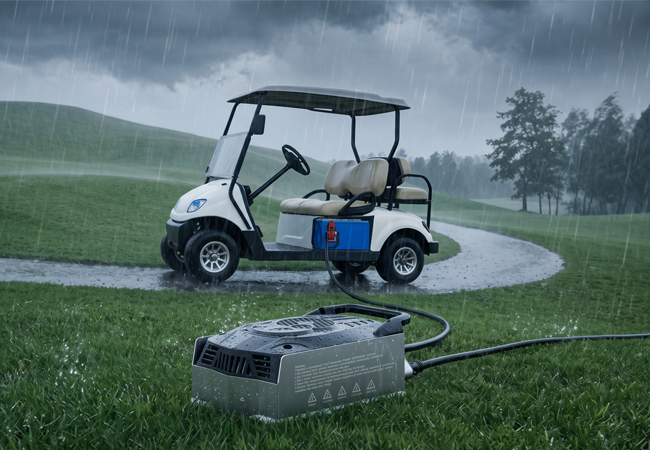
As lithium battery upgrades become the standard for golf carts, ATVs, and recreational vehicles (RVs), off-grid and outdoor charging has become a routine activity. You plug your vehicle in at a campsite or a golf course, and suddenly, an unexpected rainstorm rolls in. You cannot reach the plug in time. What happens next?
The Fatal Flaw of Standard Battery Chargers in the Rain
Many vehicle owners mistakenly assume that because their ATV or golf cart is rugged enough for the outdoors, their charging equipment shares the same durability. This is a costly misconception.
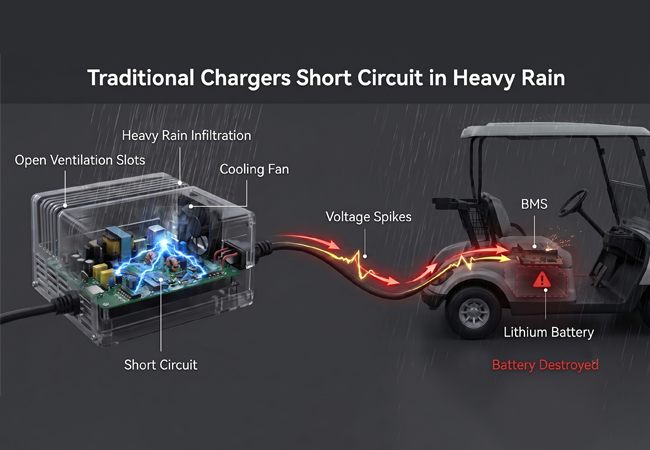
Standard conventional chargers rely heavily on open ventilation slots and internal cooling fans to dissipate the extreme heat generated during power conversion. When caught in a sudden downpour, rainwater easily penetrates these open vents. Once water bridges the gap between live electrical contacts on the motherboard, it causes an immediate short circuit. This can fry the internal circuitry instantly, and in worst-case scenarios, send a dangerous voltage spike directly into your vehicle's Battery Management System (BMS), rendering your expensive lithium battery useless.
How High-End Chargers Survive the Storm
If your lifestyle involves charging outdoors, investing in a specialized smart tech-charger is not a luxury—it is a mandatory safety measure. When evaluating chargers for outdoor resilience, industry experts recommend looking for these specific fail-safes:
IP67 Waterproof Sealing: A true outdoor charger must be completely sealed against the elements. An IP67 rating guarantees that the device is 100% protected against dust ingress and can withstand being subjected to heavy rain or temporary immersion in water.
Isolated Air Duct Design: High-performance chargers generate heat that must be managed even when sealed. The solution is an isolated air duct design. This architecture physically separates the cooling airflow from the sensitive electronic motherboard, ensuring that moisture, dust, and corrosive salt-fog never touch the critical internal components.
3000V Lightning Protection: A rainstorm often brings lightning. A sudden electrical surge from a nearby lightning strike can travel through the grid and destroy plugged-in devices. An outdoor-ready charger should feature built-in 3000V lightning protection to shield your entire electrical system from sudden surges.
Adjustable Charging Protection Time: In emergency weather, you might not be able to unplug your setup. A charger featuring an adjustable charging protection time (typically 6~24H) ensures the system will automatically shut down the power delivery, minimizing overcharging risks while unattended.

Being caught in a rainstorm while charging does not have to end in a destroyed power supply or a ruined battery. By understanding the limitations of standard equipment and upgrading to a waterproof, surge-protected smart lithium charger, you can safeguard your investment against the unpredictable forces of nature.
Post time: Sep-24-2026


