

Walk the docks at any modern marina and you will find boats where the chartplotter shows engine data, the autopilot reads the wind sensor, and the battery bank reports its state of charge to the helm display — all over a single cable running through the hull. The technology behind that integration is NMEA 2000®, the communication protocol that has become the common language of marine electronics.
This guide explains how the NMEA 2000 protocol actually works: the network it runs on, the message system it uses, how devices join the network, and what it takes for a lithium battery system to participate. Whether you are planning an electronics refit or specifying communication requirements for an OEM battery project, understanding the protocol is the first step toward a system where everything talks to everything else.
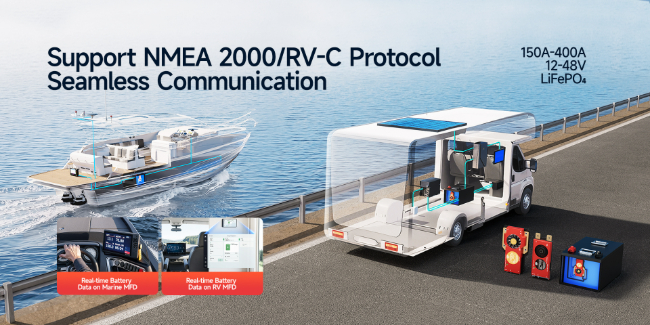
What Is NMEA 2000?
NMEA 2000 is a standardized communication protocol that allows marine electronic devices — displays, sensors, engines, and battery systems — to share data over a single network. Developed by the National Marine Electronics Association, it is built on CAN bus (Controller Area Network) technology and lets equipment from different manufacturers exchange information without custom wiring between each pair of devices.
NMEA 2000® is a registered trademark of the National Marine Electronics Association (NMEA), the US-based body that develops and maintains marine electronics standards. The protocol defines a low-cost, bi-directional, multi-transmitter, multi-receiver network: any certified device can send and receive data, the network configures itself, and there is no central controller that everything depends on.
That last point matters more than it sounds. On an NMEA 2000 network, if one device fails, the rest keep communicating. Compare that with older point-to-point wiring, where a single instrument often sat in the middle of the data chain — and when that instrument failed, every device depending on its data went dark.
In practice, boat owners and builders use NMEA 2000 to put navigation data, engine parameters, tank levels, environmental sensors, and — increasingly — battery data onto one shared backbone, visible from any compatible display on board.
NMEA 2000 vs NMEA 0183: What Changed
Before NMEA 2000, marine electronics talked over NMEA 0183, a serial protocol introduced in the early 1980s. NMEA 0183 is still found on many vessels, and understanding the difference explains why the industry moved on.
NMEA 0183 is a point-to-point serial protocol. One device — the "talker" — transmits ASCII text sentences at 4,800 baud (a high-speed 38,400-baud variant was added later, mainly for AIS vessel-tracking data) to one or more "listeners." A listener can only receive from a single talker, so connecting many instruments meant multiplexers, buffers, and wiring diagrams that grew more painful with every added device.
NMEA 2000 replaced that model with a true network:
| Feature | NMEA 0183 | NMEA 2000 |
|---|---|---|
| Architecture | Point-to-point, single talker → listeners | Multi-drop network, all devices talk and listen |
| Physical layer | Serial (RS-422/RS-232-style signaling) | CAN bus, differential twisted pair |
| Speed | 4,800 baud (38,400 high-speed variant) | 250 kbit/s |
| Data format | ASCII text sentences (max 82 characters) | Compact binary frames |
| International standard | IEC 61162-1 | IEC 61162-3 |
| Adding a device | New wiring run, possible multiplexer | Drop cable to the backbone |
| Failure behavior | Talker failure breaks the chain | Network continues without the failed node |
The two standards are not compatible. An NMEA 0183 instrument cannot join an NMEA 2000 network directly; mixed installations require a gateway device that translates between the two. For new builds and refits, NMEA 2000 is the default choice — which is why battery systems designed for marine use increasingly need to speak it.
How the Protocol Works: CAN Bus and PGNs
Under the hood, NMEA 2000 is built on Controller Area Network (CAN) — the same bus technology proven for decades in automotive and industrial systems — running at 250 kbit/s. What NMEA 2000 adds on top of raw CAN is a standardized application layer heavily influenced by SAE J1939 (the communication protocol family used in trucks and heavy vehicles): a shared vocabulary that tells every device what the bytes on the wire actually mean.
That vocabulary is organized into Parameter Group Numbers (PGNs). Each PGN is a defined message type: one PGN carries GPS position, another carries engine RPM, another carries water depth. Messages travel as CAN frames using a 29-bit identifier and an 8-byte data field; larger messages are split across multiple frames and reassembled by the receiver. Because every certified device interprets PGNs the same way, a Garmin display can read data from a Yamaha engine gateway and a third-party tank sensor without any of those manufacturers coordinating with each other.
For battery systems, a specific group of PGNs does the work:
- PGN 127508 – Battery Status: voltage, current, and temperature for a battery instance
- PGN 127506 – DC Detailed Status: state of charge, state of health, and time remaining
- PGN 127513 – Battery Configuration Status: nominal voltage, chemistry, and capacity information
Alarm and warning conditions travel separately, through the network's standardized alert messaging (PGN 126983) — which is how a battery fault becomes a visible, audible warning at the helm rather than a silent flag inside the pack.
When a battery management system (BMS) or battery gateway transmits these PGNs onto the network, any display on board that supports these PGNs can show pack voltage, current draw, and state of charge — without adding a separate battery monitor screen at the helm. Each battery is assigned an instance number, which is how a network distinguishes the house bank from the start battery and displays them separately.
This PGN layer is the exact point where lithium battery electronics meet marine electronics, and it is where integration projects succeed or stall. A BMS that measures everything but transmits nothing puts precise data in a place nobody can see it; a BMS that implements the battery PGNs makes that data part of the vessel.
NMEA 2000 Network Architecture
Physically, an NMEA 2000 network follows a simple and rigid topology — and the rigidity is a feature, because it makes networks predictable.
[ORIGINAL DIAGRAM HERE — network topology showing backbone, terminators, drop cables, and devices including MFD, engine gateway, sensors, and a lithium battery bank with BMS. Alt text: "NMEA 2000 network diagram with battery system connected via drop cable"]
The network is built from four elements:
The backbone is the main trunk cable running through the vessel. Every device connects to it; no device connects directly to another device.
Terminating resistors cap both ends of the backbone. CAN bus signaling requires termination at each end of the trunk to prevent signal reflections — a missing or doubled terminator is a common cause of a misbehaving network.
Drop cables connect each device to the backbone through T-connectors. The standard defines maximum lengths for both the backbone and individual drops, which keeps signal timing within specification as networks grow.
Network power is supplied over the backbone itself. NMEA 2000 cabling carries its own power feed for the network interfaces of connected devices, separate from the vessel's main DC loads.
Devices use standardized 5-pin connectors (commonly Micro-C) on shielded twisted-pair cable, using differential signaling for noise immunity — a meaningful advantage in an environment full of alternators, inverters, and radio transmitters.
For a battery installation, this architecture has one practical implication worth planning early: the battery bank's communication interface needs a drop-cable route to the backbone, and networks with multiple battery banks need their instance numbers configured so each bank appears as a distinct source on the displays.
What Devices Connect to an NMEA 2000 Network
Almost every category of marine electronics now ships with NMEA 2000 connectivity:
Multi-function displays (MFDs) are the consumers of network data — chartplotters and instrument displays from the major marine electronics brands read PGNs and present them to the operator. On most vessels the MFD is where battery data ultimately gets seen.
Engine gateways translate proprietary engine data onto the network, putting RPM, fuel flow, and engine alarms on the same displays as everything else.
Sensors — depth, wind, GPS, temperature, tank level, fuel flow — are the network's data producers, each transmitting its own PGN set.
Autopilots and radios both consume navigation data and, in the case of VHF radios with DSC (Digital Selective Calling), use network GPS data for distress calls.
Battery and power devices are the fastest-growing category. Battery monitors, shunts, DC energy meters, and lithium battery systems with communication-capable BMS electronics transmit the battery PGN group described above, turning the helm display into a power management screen. How marine displays read and interpret lithium battery data is a deep enough topic that we cover it in its own guide. How Marine Electronics Read Lithium Battery Data →
If you are evaluating a lithium battery for a boat, communication capability belongs on the checklist alongside capacity and discharge ratings — our marine lithium battery selection guide covers how to weigh it against the rest of the specification. Marine Lithium Battery Selection Guide →
Certification and Compliance
One aspect of NMEA 2000 that surprises many buyers: it is not an open, use-it-however protocol. NMEA 2000 is a licensed standard, and all products that read or transmit NMEA 2000 data are required to be certified under the NMEA 2000 License Agreement (source: NMEA). Certification testing can be performed by the manufacturer using NMEA's certification tooling or by a third party, and the standard's licensing fees are tiered by industry.
Certification exists for a practical reason: it is what makes the "any device, any brand" interoperability promise real. A certified device has demonstrated that it transmits mandatory messages correctly, responds properly to network management requests, and does not disrupt the bus for everyone else.
For OEM builders and system integrators, this has a planning consequence. When a communication-capable battery system is designed into a boat, certification is a defined step in the product path — with documented hardware and software test requirements — rather than an afterthought. Who certifies what, and at which level of the finished product, is a question to settle early in a project. We walk through how OEM teams typically handle communication integration and the certification path in our OEM integration guide. How OEMs Integrate NMEA 2000 Communication →
NMEA 2000 and Lithium Battery Systems
Lithium iron phosphate (LiFePO4) batteries changed what marine electrical systems can do — higher usable capacity, faster charging, and — through the battery management electronics they carry — far more onboard data. But that data only creates value when it reaches the operator, and on a vessel with networked electronics, the most direct route to the operator is the NMEA 2000 network.
A lithium battery system participates in the network through its BMS or through a communication gateway that translates BMS data into the standard battery PGNs. Once on the network, state of charge appears on the chartplotter, low-voltage conditions trigger alarms at the helm rather than silently in the battery compartment, and multiple battery banks can be monitored side by side through their instance numbers.
For custom and OEM battery projects, communication requirements deserve the same rigor as electrical requirements. The questions that determine integration success are specific: Which PGNs must the system transmit? How many battery instances will the vessel run? Does the project require native network connectivity or a gateway architecture? Is certification handled at the battery level or the vessel-system level?
DALY's engineering team supports NMEA 2000 communication integration for marine battery projects, with protocol adaptation available per project requirements. If you are planning a custom lithium battery project, share your vessel type, battery configuration, and the data your displays need to show at the RFQ (request for quotation) stage — our engineering team will respond with a communication scheme recommendation and a quotation. Defining the PGN set, instance configuration, and certification path early is the difference between an integration that drops into place and one that gets redesigned at sea trial.
Frequently Asked Questions
Q1What is the NMEA 2000 protocol based on?
NMEA 2000 is built on CAN (Controller Area Network) bus technology, with a standardized marine application layer influenced by SAE J1939. The CAN foundation provides the physical network and error handling; the NMEA 2000 layer defines what the messages mean.
Q2Is NMEA 2000 the same as CAN bus?
No. CAN bus is the underlying network technology; NMEA 2000 is a complete protocol standard built on top of it. Two devices can both use CAN and still be unable to understand each other — NMEA 2000's PGN message definitions are what create interoperability between marine devices.
Q3What speed does NMEA 2000 run at?
NMEA 2000 operates at 250 kbit/s — roughly fifty times faster than standard 4,800-baud NMEA 0183, and fast enough to carry navigation, engine, and battery data for a typical vessel on a single backbone.
Q4Can lithium batteries connect to an NMEA 2000 network?
Yes. A lithium battery system joins the network through a BMS or gateway that transmits the standard battery PGNs — 127508 (Battery Status), 127506 (DC Detailed Status), and 127513 (Battery Configuration Status) — allowing compatible displays to show voltage, current, and state of charge. The implementation approach (native interface or gateway) is defined per project.
- Email: dalybms@dalyelec.com
Smart BMS product page: https://www.dalybms.com/smart-bms/
Post time: Jul-25-2026


