

Quick Answer: No, you should not leave your RV lithium battery plugged in all winter. Holding a lithium battery at 100% state of charge for months accelerates capacity degradation, and continuous trickle charging can cause severe internal stress. The safest method is to store the battery at a 50% to 80% charge, disconnect it entirely, and use a smart lithium charger with an automatic cut-off for periodic top-ups every few months.
The Myth of Winter Float Charging The confusion stems from lead-acid battery chemistry. Lead-acid batteries self-discharge quickly and require a constant "float charge"—a low-voltage trickle—to prevent sulfation and freezing during winter.
LiFePO4 (Lithium Iron Phosphate) batteries operate on a completely different chemical principle. They possess an extremely low self-discharge rate and actively resist continuous float charging. Once a lithium cell reaches its maximum voltage, applying further current—even a tiny trickle—generates internal heat and stress. Furthermore, keeping a lithium battery at 100% capacity for extended periods significantly shortens its overall lifespan. The healthiest state for a resting lithium battery is between 50% and 80% charge.
The Fail-Safe Approach to Winter Storage Experienced off-grid enthusiasts recommend a simple routine: charge the battery to around 80% before winter, use the main disconnect switch to eliminate parasitic electrical draws, and walk away. Every one to two months, reconnect the system to a smart lithium charger to top off the minor capacity loss.
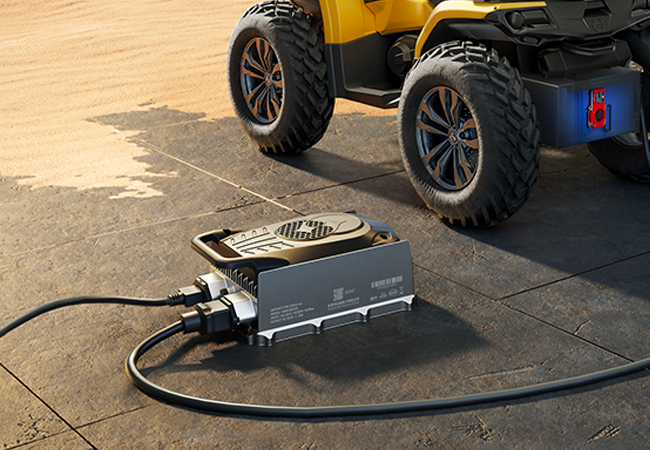
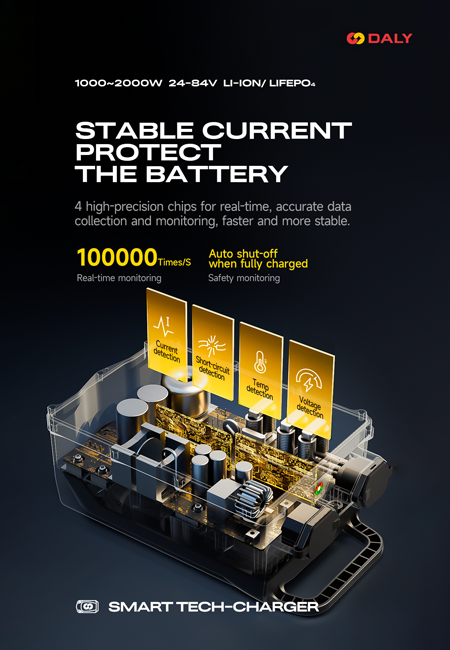
To execute this properly, upgrading to a high-quality smart charger is essential. When selecting a charger for your off-season maintenance, look for these specific engineering standards:
True Automatic Cut-Off: The charger must strictly follow a Constant Current/Constant Voltage (CC/CV) curve and stop outputting power completely once the target voltage is reached. It should ideally be linked with the battery's Battery Management System (BMS) for dual safety and dual intelligence, ensuring the charging profile perfectly matches the cell's status.
The Fail-Safe Timeout: While auto-cut-off is standard, extreme cold or a BMS glitch can sometimes cause the system to misread voltage, forcing the charger to run endlessly. This is where an adjustable charging protection time (ranging from 6 to 24H) becomes a critical fail-safe. If the battery does not reach its target within the set timeframe, the charger forces a system shutdown, preventing catastrophic overcharging while unattended.
Undervoltage Activation: If you forget to disconnect your RV's parasitic loads (like carbon monoxide detectors or radio memories), the battery will drain to 0V, causing the BMS to enter sleep mode. A proper maintenance charger must feature undervoltage activation to rescue over-discharged batteries and safely wake the system.
Rugged Environmental Shielding: Winter storage facilities are rarely climate-controlled. An isolated air duct design ensures the cooling airflow is separated from the motherboard, making the charger dust, moisture, and salt-fog resistant during the damp winter months.
Storing your RV battery correctly does not require continuous grid power. By understanding lithium chemistry and utilizing a smart charger equipped with true auto-shutoff and emergency timeout features, you can maximize your battery's lifespan and ensure it is ready for the spring camping season.
Post time: Sep-29-2026


