

Quick Answer: Different SOC Does Not Automatically Mean a Battery Fault
If parallel LiFePO4 battery packs show different SOC values, do not start by forcing the displayed percentages to match.
First compare the packs under the same operating condition. Check SOC together with pack voltage, pack current, and BMS operating or protection status.
A useful first decision is: Is only the displayed SOC different, or is one pack also behaving differently?
SOC is one diagnostic signal, not the diagnosis. Diagnose before you correct.
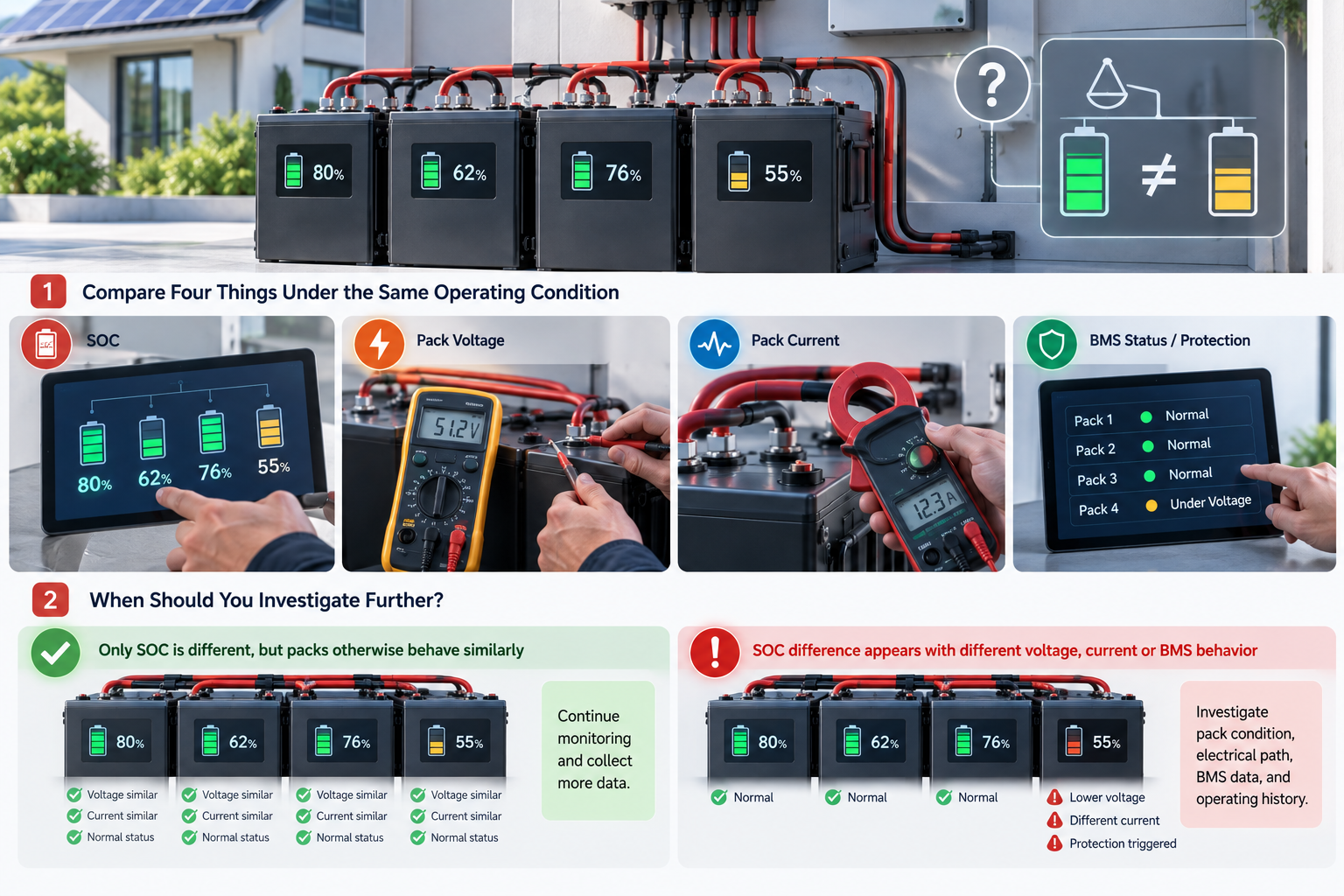
1. Compare Four Things Under the Same Operating Condition
Compare the packs at the same point in operation—for example during the same charge period, discharge period, or rest condition.
| Check | What it helps you understand | Do not conclude from it alone |
|---|---|---|
| SOC | Whether the BMS units report different state-of-charge estimates | A different SOC number alone does not prove a battery fault |
| Pack voltage | Whether the packs show different electrical conditions | Similar voltage does not prove identical SOC |
| Pack current | Whether one pack behaves differently under the same system condition | One current snapshot does not explain the root cause |
| BMS status / protection | Whether one pack reaches a limit or enters a different state | A status event still needs operating context |
2. When Should You Investigate Further?
| What you observe | Recommended next step |
|---|---|
| SOC values differ, but the packs otherwise behave similarly | Continue monitoring under comparable conditions and collect more data before changing settings |
| SOC difference repeatedly appears with different voltage or current behavior | Investigate pack condition, electrical path, BMS data, and operating history |
| One pack repeatedly reaches protection or stops charging/discharging earlier | Treat this as stronger evidence of a pack-level or system-integration issue and investigate before continued operation |
There is no single universal SOC-difference percentage that diagnoses every parallel LiFePO4 system.
3. Do Not Use Pack Voltage Alone as an SOC Test
Pack voltage is useful supporting evidence, but it should not be used as a universal one-to-one SOC indicator for LiFePO4 batteries.
Compare voltage with SOC, current, and operating status—not instead of them.
4. Separate Pack-to-Pack SOC Difference From Cell-Level Imbalance
A difference between the SOC values of two battery packs is a pack-level observation. Cell imbalance describes differences among cells inside one battery pack.
Active balancing may help address cell-level voltage imbalance within a pack when appropriate. It should not be treated as an automatic solution for different SOC readings between parallel battery packs.
5. Use Individual Pack Visibility to Find the Outlier
For supported DALY 4th Gen Home Energy Storage BMS configurations, multi-pack monitoring can show individual pack information for up to 16 parallel packs.
| Visible information | How it helps |
|---|---|
| Pack number / state | Identify which pack behaves differently |
| Voltage | Compare pack electrical condition |
| Current | Compare current behavior under the same system condition |
| SOC | Track whether the difference persists or changes |
| CHG-MOS / DSG-MOS | Check whether a pack is in a different charge/discharge state |
6. What Should You Send DALY for Verification?
| Information | What to provide |
|---|---|
| Battery configuration | Chemistry, S count, capacity per pack |
| Parallel system | Number of packs and BMS model |
| Synchronized pack data | SOC, voltage, current, and BMS status under the same operating condition |
| Inverter | Exact brand and model |
| Communication | CAN / RS485 and protocol, if applicable |
| History | When the difference appears: charge, discharge, rest, or after protection events |
FAQ
Should parallel LiFePO4 battery packs always show exactly the same SOC?
Not necessarily. A different displayed SOC value alone does not diagnose a fault. Compare the packs under the same condition using SOC, voltage, current, and BMS status.
If two packs have similar voltage, should their SOC be the same?
Not necessarily. LiFePO4 pack voltage is useful supporting evidence, but it is not a universal one-to-one SOC indicator.
Will active balancing fix different SOC values between parallel battery packs?
Not automatically. Active balancing addresses cell-level imbalance within a battery pack. Pack-to-pack SOC difference should first be diagnosed as a separate observation.
Request a Parallel Battery Diagnostic Review
If parallel packs repeatedly show different SOC together with different voltage, current, or BMS status, send DALY the battery configuration, number of packs, BMS model, synchronized pack data, inverter model, communication requirement, and operating history.
The technical team can then review the actual pack behavior instead of diagnosing the system from SOC percentage alone.
Post time: Sep-10-2026


