

A frequent question pops up on EV forums, solar DIY communities, and technical support desks: "My 20A smart lithium charger starts strong, but after a while, the current drops to 10A and then 5A. Is the charger failing, or are the internal components worn out?"
If you are experiencing this, you can probably breathe a sigh of relief. Seeing the amperage taper off is rarely a sign of hardware failure. In most cases, your hardware is working exactly as engineered. This decline is the defining signature of a healthy CC/CV (Constant Current / Constant Voltage) charging curve.
Think of charging a lithium battery like parking a car. When you first enter an empty parking lot, you can drive quickly to the spot. But as you get closer to the curb, you must slow down to a crawl to avoid a collision. A smart lithium charger uses similar, self-adjusting logic to prevent overvoltage, plating, and thermal issues as the battery fills up.
Unlike basic power supplies that push a static, brute-force output, a properly programmed lithium charger dynamically shifts its behavior based on the battery’s State of Charge (SoC):
The Three Critical Stages of a Lithium Charger
Stage 1: Constant Current (CC) | 0% – 80% SoC
The Charger’s Action: It delivers the maximum rated current (e.g., a steady 20A) while the battery’s voltage steadily rises.
Why It Happens: At this stage, the battery is relatively "hungry" with low internal resistance. It can safely and rapidly absorb large amounts of bulk energy without issue. This is where the bulk of your charging speed comes from.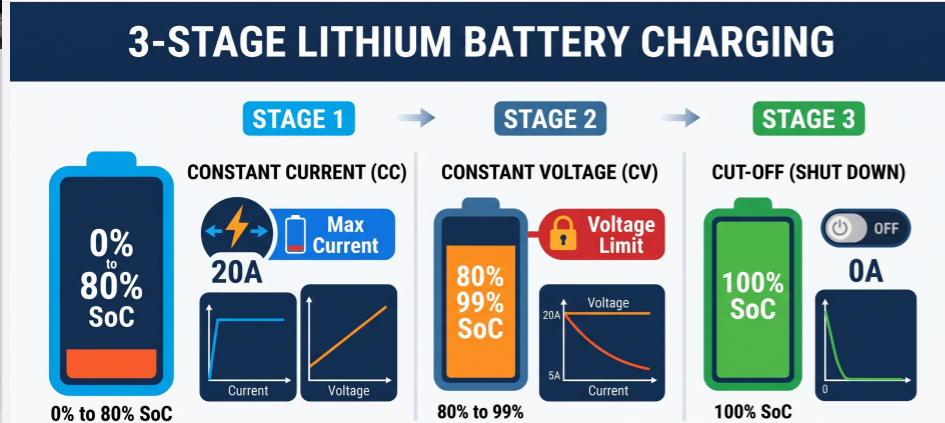
Stage 2: Constant Voltage (CV) | 80% – 99% SoC
The Charger’s Action: It locks the output voltage at its target peak (absorption ceiling), while the current naturally and gradually tapers down (e.g., 20A → 10A → 5A).
Why It Happens: As the internal cell voltage closely approaches the charger's peak limit, the "pressure difference" between the charger and the battery shrinks. By letting the current naturally ease off, the charger safely Tops off the cells, preventing irreversible "lithium plating" or overheating as it crams the final 20% of capacity into the pack.
Stage 3: Cut-Off (Termination) | 100% SoC
The Charger’s Action: The current drops to 0A, and the charger completely shuts down or enters standby.
Why It Happens: When the current falls below a tiny preset threshold (typically around 0.05C), the charger shuts off entirely. This prevents the continuous "float-charging" stress that can cause lithium cells to degrade or bloat over time.
When your meter reads 5A instead of 20A, your charger has simply transitioned from Stage 1 (CC) to Stage 2 (CV). It is not losing its capability; it is actively protecting your battery pack.
When a Current Drop Actually Signals a Problem
While a gradual drop at 80% SoC is normal, an early or sudden drop (for example, dropping to 5A when the battery is only at 30% capacity) does warrant inspection. Before assuming the charger is defective, consider these three real-world issues:
Premature CV Trigger from Resistance: Loose terminal bolts, corroded connectors, or undersized charging cables create resistance. This resistance causes a "voltage drop" across the wire, tricking the charger into reading a higher voltage than the battery actually has. Thinking the battery is almost full, the charger enters CV mode too early and throttles down the current.
Active BMS Throttling: If you are using a smart charger that communicates with the battery’s BMS (via CAN bus or RS485), the BMS may actively command the charger to reduce current if it detects high cell temperatures or voltage imbalances between individual cells.
Thermal Derating: Heavy-duty chargers feature built-in thermal protection. If the charger is operating in a poorly ventilated compartment, direct sunlight, or extreme ambient heat, it will intentionally reduce output amperage to cool down rather than shutting off completely.
How to Troubleshoot
To verify if your charger is healthy, check the battery’s voltage or SoC when the drop occurs. If the battery is above 80% and sitting right at its target absorption voltage, your charger is doing its job perfectly. If it happens when the battery is low, check your cable connections and ensure the charger has plenty of cool airflow—resolving those physical bottlenecks usually restores full 20A output immediately.
Post time: Nov-28-2026


